

Copper Theft Surges
A Wall Street Journal report details a nationwide surge in copper thefts that is increasingly hitting emergency communications and public-safety networks. Telecom companies reported 9,770 incidents of intentional copper theft or sabotage from January to June — nearly double the previous six-month period — disrupting service for more than eight million customers. AT&T says the damage has cost the company $76 million this year as thieves pry open manholes, cut underground cables, and strip copper from poles, sometimes posing as workers. Police departments, telecom investigators, and the FBI are treating many cases as organized theft rings, using GPS trackers embedded in wiring, security cameras, and scrapyard reporting databases to identify suspects. Fourteen states have enacted new laws in 2025 to tighten oversight of scrapyards and strengthen penalties, and companies are accelerating efforts to replace vulnerable copper with fiber where possible. 🔗 More here
Police Paired with Guard
In the wake of this week’s attack that killed one National Guard member and critically injured another, D.C. leaders are weighing a major shift: requiring local police officers to accompany National Guard troops on patrol. The move would reverse months of practice in which the Guard has operated largely on its own under the federal crime-reduction mission. Police officials caution that pairing officers with troops could pull resources from neighborhood calls, while federal officials say the change is needed to better protect the roughly 2,000 deployed Guard members. Meanwhile, the entire deployment is still tied up in court as judges consider whether the mission itself is lawful. 🔗 More here
Leadership Is About Being Present

Fort Worth’s new police chief Eddie García has spent his first months in the job holding dozens of community town halls across the city as he works to build public trust and introduce himself to residents. García, who took the oath in September after previously leading the Dallas and San Jose police departments, has been meeting neighborhood groups, community advocates, and Citizens on Patrol members to hear local concerns and outline his vision for the department. He has emphasized that “leadership is being present,” telling residents that officers should be visible before crises occur, not only after. According to the Fort Worth Report, García says the outreach helps both the public and officers, reinforcing the purpose behind the work as the city continues to grow. He has pledged to continue meeting with residents across Fort Worth and sees community requests for police presence as “a gift” he intends to protect. 👮♂️ More here
Chinese Drone Ban Weeks Away
The Verge reports that the United States is on track to automatically ban DJI — the world’s largest drone manufacturer — from importing any new products into the country starting December 23, unless a national security agency completes a formal audit clearing the company of risk. That audit has not begun. The ban would cover drones, cameras, and any DJI-made device containing a wireless radio, and the FCC has now given itself authority to retroactively block previously approved products as well. Lawmakers from both parties cite espionage and data-security concerns. The impact will be immediate: DJI drones dominate U.S. public safety, agriculture, energy, and inspection work, and many domestic competitors have shifted to military and enterprise markets, leaving few viable replacements. Some retailers have begun quietly stocking non-US versions of DJI hardware ahead of the cutoff, and the company has explored selling rebranded products under different names, which regulators can also block. 🇨🇳 More here
Weighing ICE Cooperation
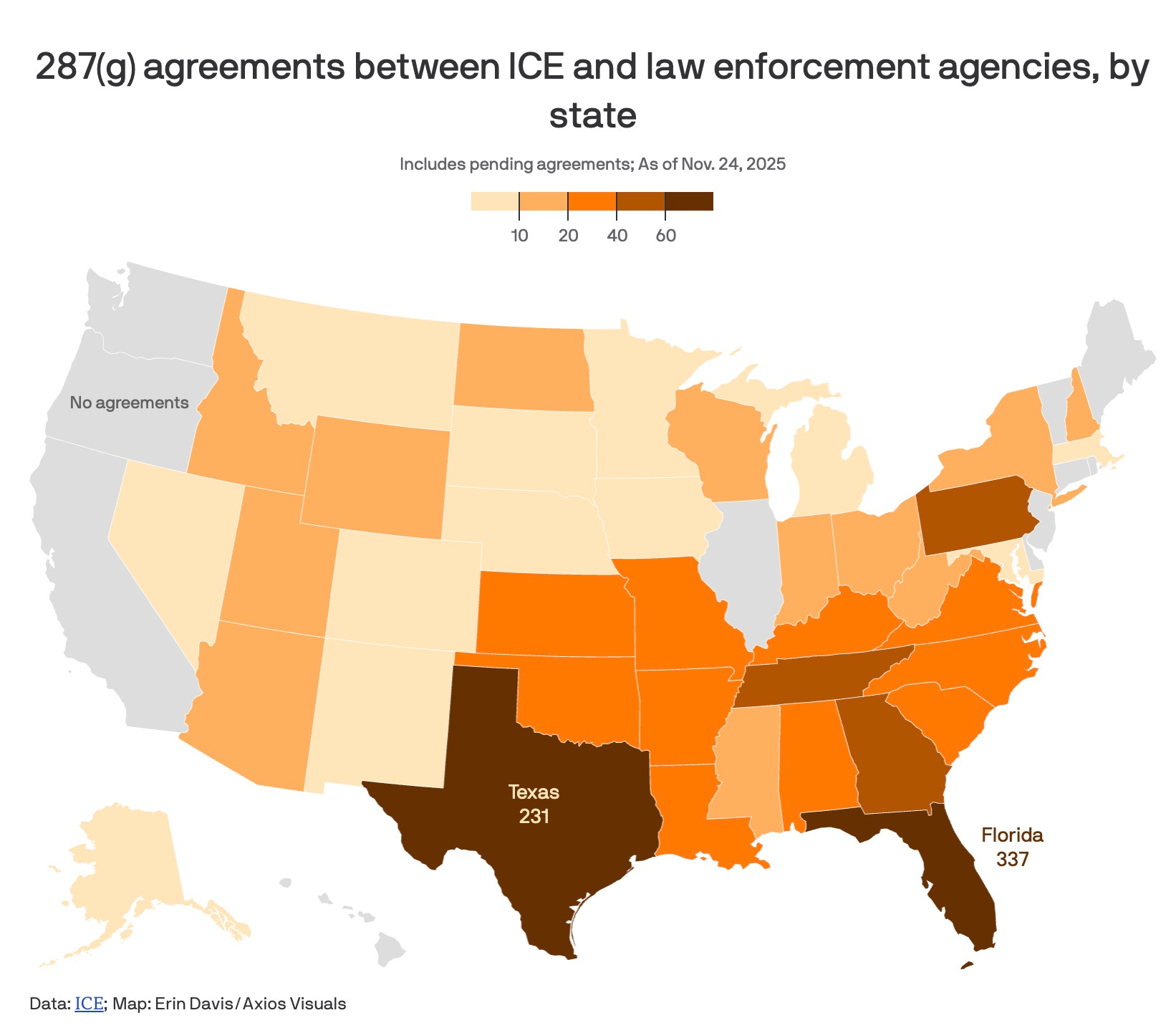
The largest police departments in Texas are facing new decisions as federal immigration operations intensify. According to NBC News, Dallas Police Chief Daniel Comeaux declined an offer from ICE that included up to $25 million in reimbursements, saying the program would reassign officers under federal oversight and negatively affect response times and ongoing efforts that have coincided with lower homicide rates, reduced violent crime, fewer traffic deaths, and improved response metrics in the city. Houston, meanwhile, has seen calls from its police department to ICE rise 1,000% since President Trump’s reelection, largely from traffic stops, though the department says it does not enforce immigration laws and only contacts ICE when officers encounter individuals with warrants listed in the national database. Statewide, Texas law requires sheriffs in counties with more than 100,000 residents to sign agreements with ICE by December 2026, and the Department of Public Safety has already partnered with the agency. DHS says the 287(g) program now includes salary reimbursements, overtime coverage, and performance awards for local agencies. Despite that, none of the police departments in the nation’s 10 largest cities — including Houston, Dallas, and San Antonio — have signed on as 287(g) partners, according to ICE’s published list. 🔗 More here
Local Police Central to ICE
The Trump administration is increasingly turning to local law enforcement to support federal immigration operations, with more than 1,100 new 287(g) agreements signed this year that allow sheriff’s offices, state police, and other agencies to assist with immigration arrests and detainers. Axios reports that nearly 650 counties now participate in some form of the program, and ICE has added new incentives, including reimbursement for each trained officer’s salary, benefits, and a portion of overtime, plus performance bonuses tied to locating individuals flagged by the agency. Florida and Texas lead with the highest number of agreements after passing laws requiring broad cooperation, and several large sheriff’s departments and highway patrol agencies are now authorized to assist ICE in the field. ICE officials say the partnerships help address staffing shortages as the agency works toward its hiring goals, while some community groups have opposed the expansion by citing local costs or past litigation, though those efforts have seen mixed results. 🔗 More here
AI Translation for Police
Departments nationwide are adopting real-time translation technology to help officers communicate with residents who speak languages other than English, especially following the administration’s directive for federal agencies to review multilingual services. According to USA Today, Officers in cities such as Tampa report that Axon’s body-worn camera translation feature now allows them to gather details directly during calls for service, eliminating delays that came with waiting for a bilingual colleague or third-party phone interpreter. Agencies in states including California, Colorado, Illinois, and Indiana say the tools have already proved useful during traffic stops, theft reports, and routine community interactions. Pocketalk, a handheld translator used by departments in 19 states, is also expanding as agencies look for practical ways to bridge language gaps during everyday policing. Departments using these tools say they have improved officer safety, reduced response times, and made basic communication easier during field encounters. 🗣️ More here
Clearance Rates Reach Highs
New crime data shows D.C. police are closing homicide cases at a rate not seen since 2013, with roughly 30% fewer killings this year and 104 suspects arrested so far — already surpassing last year’s total. As of Nov. 21, investigators have cleared nearly four of every five homicide cases opened in 2025, including 58 cases from this year and another 40 from previous years counted toward the clearance rate. The surge in arrests aligns with a sharp increase during September, when police made 19 homicide arrests compared to two in the same month last year. Police leadership credited detectives, community cooperation, prosecutors, and the multiagency Capital Area Regional Fugitive Task Force for the results. Officials also noted that this year’s arrest totals include suspects in cases as varied as fatal stabbings, hit-and-run homicides, the killing of a 3-year-old, and the death of a National Guard member. 📈 More here
Rethinking Police Response
A new peer-reviewed article Police Quarterly by Dr. Loren Atherley analyzes three years of Seattle’s 911 data (over 727,000 calls across 356 call types) using a risk-management framework adapted from commercial aviation to determine when it is actually safe to send unarmed responders. The research finds that nearly 49% of call types show no credible worst-case scenario requiring an armed response and could be handled by specialized, non-police units if properly screened. By modeling severity and likelihood of harm using medical data from fire/EMS reports—not police reports—the study concludes that a diversified response system could safely free up approximately 26% of sworn officer workload, allowing police to concentrate on violent crime and high-risk emergencies. The study also confirms “Ratcliffe’s Paradox”: in today’s system, many calls appear safe only after an armed officer assesses the scene, meaning police remain essential gatekeepers for identifying which incidents are appropriate for alternative responders. Overall, the findings suggest that with structured risk policy, tiered triage, and police-led safety assessments, agencies could expand specialized responses without compromising officer or public safety. 🚓 Full article here
New Pod Coming: Kristen Mahoney

Coming this week, my conversation with longtime public safety leader Kristen Mahoney. We trace her path from the Baltimore Police Department to Maryland’s Governor’s Office of Crime Control and Prevention and ultimately the Bureau of Justice Assistance, where she helped oversee billions in federal grants. Kristen reflects on the rise of evidence-based and SMART policing, the essential role of civilian professionals, and the federal government’s unique convening power. Kristen also shares insights from her work with the University of Chicago’s Policing Leadership Academy and the growing push to equip future police leaders with data-driven, problem-solving skills and the need to be curious amid rapid technological and cultural change.
🚔 Daily police news @ Police Briefing