

After several weeks away on sabbatical — a benefit my company extends to long-tenured employees — I'm back. I completely unplugged during this time. I want to welcome the wave of new subscribers who joined while I was out — glad you're here. As we get back into the rhythm, if you have suggestions on how to make the Weekly Briefing more useful to you, or know a law enforcement leader who would make a great podcast guest (we have several already recorded and ready to release) send it my way at mikewagers@gmail.com.
Flock Used to Stalk Women
At least 50 law enforcement officers have been charged with or accused of using Flock Safety’s license plate reader network to stalk, monitor, or harass women — in most cases their wives, girlfriends, or exes — according to a major investigative report by the Washington Post. The investigation documents cases where officers used the technology to track women’s visits to abortion clinics, confront them during intimate moments, show up at their locations uninvited, and psychologically manipulate them with knowledge of their movements. In one case, a Georgia police chief searched his ex-girlfriend’s plate roughly 600 times over 13 months, often between midnight and 4 a.m., before being arrested on stalking charges. He died by suicide before trial. Flock’s CEO acknowledged the misuse is “inevitable” but said the company’s audit logs help catch perpetrators after the fact — a response critics say amounts to a performance of accountability rather than meaningful prevention. Privacy advocates argue basic fixes — like requiring a criminal case number for every search — could deter abuse, but Flock has made such safeguards optional. PERF Executive Director Chuck Wexler offered the most measured assessment: “Very often a technology will be farther ahead of policy, and that’s what has happened with license-plate readers.” 🔗 More here
New Controls Spark Debate
Flock Safety data retention changes spark debate among regional law enforcement, community advocates in New York State.
Biggest Crime Drop in History
The FBI’s 2025 Uniform Crime Report — released Friday — shows the murder rate hit a 20-year low, with an 18.1% year-over-year decline and the single largest one-year drop in violent crime ever recorded, according to CBS News. Aggravated assault fell 7.2%, rape declined 7.6%, robbery dropped 18.5%, motor vehicle theft fell 22.7%, and burglary decreased 15.8%. “This is the third straight year of a record drop in murder and the data for 2026 points to a continued large drop this year,” said crime analyst Jeff Asher. One troubling counter-trend: assaults on law enforcement officers reached a 10-year high, with 90,178 officers assaulted in the line of duty. Experts caution against attributing the decline to any single policy or leader. “Rates are falling in cities with very different public safety strategies, economic conditions, and political leadership,” said Adam Gelb of the Council on Criminal Justice. “The consistency across the map should make us cautious about handing credit to any one leader, party, policy, or program before the evidence catches up.” In Buffalo, a 27-year homicide detective credited the drop to community trust, technology, and a shift in public attitude: “I’ve seen a real change. There is a huge uptick of people just not willing to put up with it anymore.” 📉 More here
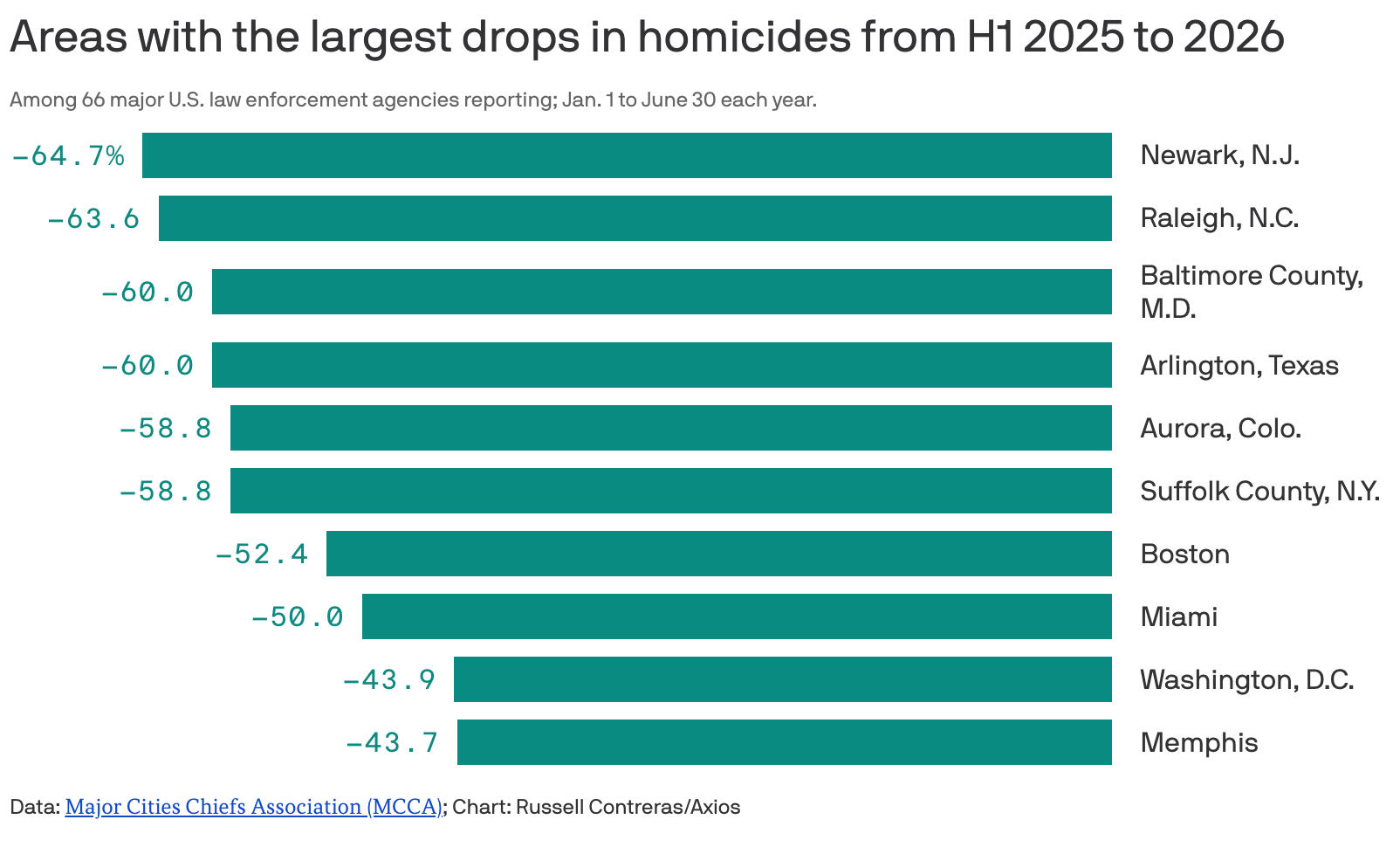
Chart: Axios. Click here for the full breakdown.
Officers Shot Down Sharply
198 law enforcement officers have been shot in the line of duty through July 31, 2026 — flat compared to the same period last year but down 12% from 2024, according to the Fraternal Order of Police’s monthly report. Of those, 17 were killed by gunfire, a 34% decline from last year and 46% below 2024 levels. There have been 27 ambush-style attacks so far this year, resulting in 36 officers shot and 6 killed. The numbers are trending significantly below recent years — at this point in 2023, 228 officers had been shot, the highest on record through the first seven months of any year. 🔗 FOP Report
Our Next 9/11 is Coming
Texas lawmakers are examining how to better equip local law enforcement to counter Mexican cartel drone activity along the border, after testimony revealed the scale and sophistication of the threat, according to The Center Square. El Paso Police Sgt. Cory Balke told a state Senate committee that cartels are using the same advanced drones as law enforcement — some worth $30,000, capable of identifying a person at a mile and tracking moving vehicles. His department has logged 1,776 confirmed cross-border drone infiltrations carrying digital signatures, but estimates the actual number closer to 14,000 when accounting for electric drones that emit no signal. Agricultural drones used by cartels can carry up to 200 kilograms of contraband at a time. Balke called on the legislature to expand local authorities and funding for both drone and counter-drone programs. A drone technology specialist testifying before the committee warned of the broader threat: “Our next 9/11 is coming. The question is whether Texas builds the defenses before it arrives.” Nationally, only 61 officers have been certified through the SAFER SKIES Act counter-drone training program since its passage last year. 🔗 More here
Kansas City Chief to Retire
After nearly three decades in uniform, Kansas City Police Chief Stacey Graves is preparing to hand over the badge after announcing her retirement. Chief Graves is a Weekly Briefing subscriber (and has helped spread the word to others). She has been on the podcast. Congratulations and best wishes for what comes next.
Briefing Room Podcast with Chief Graves, here.
Does He Ever Sleep?
Six weeks into his tenure, Honolulu Police Chief David Lazar has logged an unusually visible start — walking beats in multiple districts, attending community events, launching a drone pilot program, and establishing a formal policy prohibiting officers from collaborating with ICE, according to Honolulu Civil Beat. “My biggest question is, does he ever sleep?” said Police Commission member Chris Magnus. “I’ve really never seen a new police leader who has put as much time and effort into building relationships.” Lazar, a retired San Francisco assistant chief and HPD’s first mainland chief in more than 90 years, has also made officer recognition a standing feature of command staff meetings and is prioritizing officer wellness, recruitment, and retention — including pursuing childcare facilities for officers. He has promised to release body camera footage promptly after officer-involved shootings. Community observers note the early energy is encouraging but the real test will come in a crisis. “He’s engaged, and he’s visible,” said one police reform consultant. “But those are early indicators of leadership, not yet evidence of institutional reform.” 🔗 More here
Myrtle Beach Names New Chief
Frederick Chambers, deputy chief of Fairfax County Police Department, has been selected as the next chief of the Myrtle Beach Police Department, replacing Amy Prock who retired in April after nearly 30 years, according to the Post and Courier. Chambers, a Marine Corps veteran and former U.S. Secret Service employee who joined Fairfax County in 2001, will become the city’s first Black police chief when he begins in late September or early October. He will oversee a $56 million budget and nearly 375 officers and staff. Chambers described his approach as “data-driven, intelligence-led,” adding: “Bad guys operate off trends and patterns, and we have to follow those trends and patterns — try and get out in front of it and keep this community safe.” More than 100 people applied for the position. 🔗 More here
Inside 287(g) Program
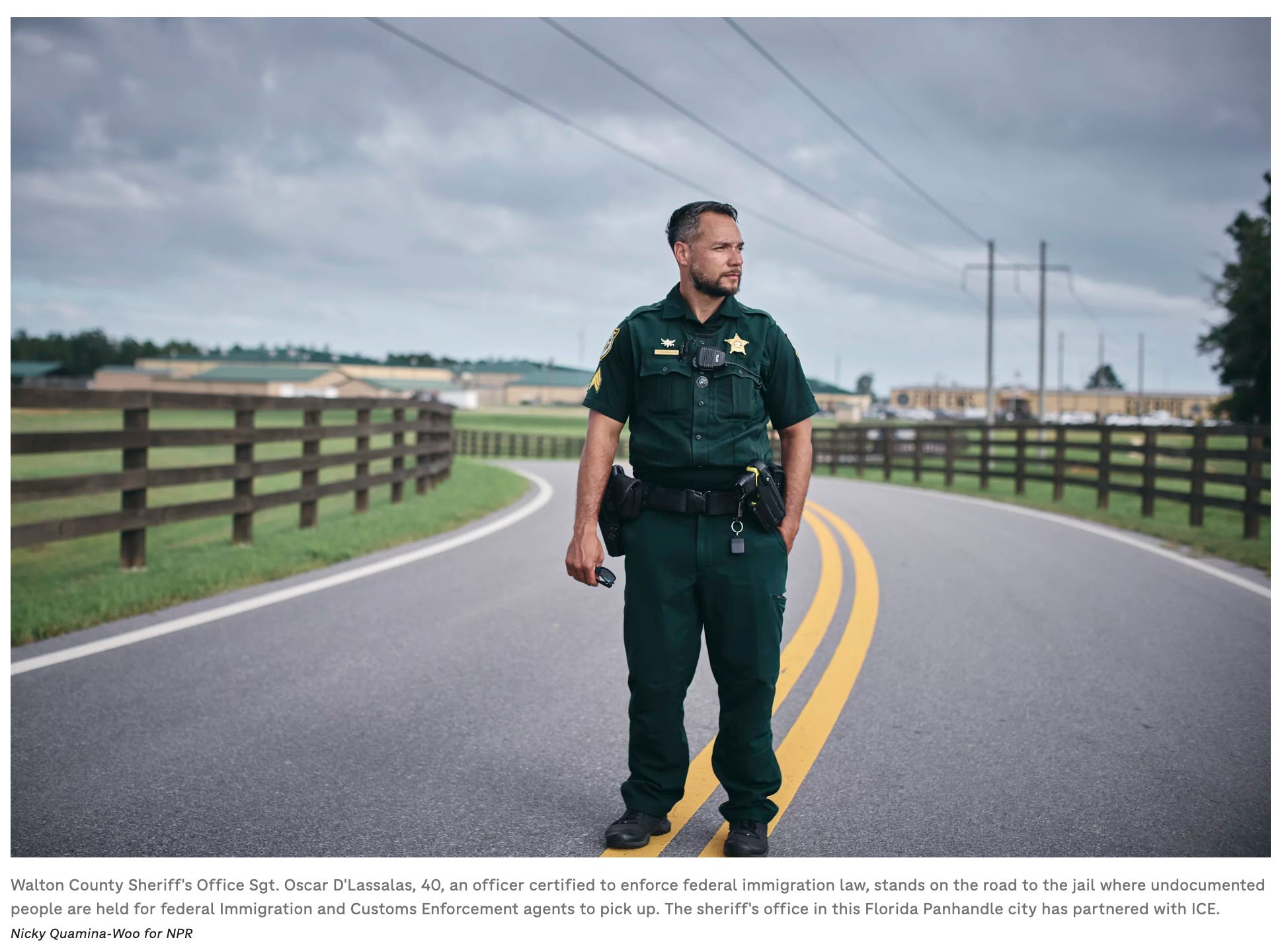
As the 287(g) program spreads — which deputizes local officers to enforce federal immigration law — NPR takes an inside look at how it operates in Walton County, Florida, where all 67 counties have signed cooperation agreements with ICE. Walton County Sheriff Michael Adkinson is direct about his department’s role and its limits. “We’re certainly not out doing immigration raids. That’s not what we do,” Adkinson said. “But if we come across those individuals who are committing a crime or endangering someone else, in the state of Florida, then we’re certainly going to do that.” Adkinson also acknowledged one of the program’s most difficult side effects — crime victims in the immigrant community who are too afraid to call police. “They don’t come to us because they’re afraid of being deported,” he said. “It’s extremely problematic. And I don’t know how we overcome that.” The county’s 287(g) task force officer, Sgt. Oscar D’Lassalas — himself the son of a Colombian immigrant — says his approach on patrol hasn’t fundamentally changed. “I make sure that anytime I interact with anybody, I don’t care what status they are, that we can interact as human beings and we can be respectful.” More here
ICE Monitors Social Media
ICE has deployed a round-the-clock digital surveillance program — using private contractors — to scan public social media platforms for speech that could endanger agents or disrupt immigration operations, according to an investigation by the Wall Street Journal. ICE spending on surveillance technology surged to $258 million in the first year of the current administration, a 57% increase from the prior year. Contractors prepare daily reports identifying posters by name, location, date of birth, workplace, Social Security number, and criminal history when possible. DHS says the program is a response to an 8,000% increase in death threats against agents since January 2025, and that all investigative methods abide by the Constitution. The agency has sent hundreds of subpoenas to social media companies to unmask anonymous accounts, and has successfully prosecuted several Americans for posts that crossed into explicit threats against agents. 🔗 More here
Electric Shock Gloves
ICE is planning to spend up to $20 million to equip officers with gloves capable of delivering electric shocks to gain compliance from combative individuals, according to an AP exclusive. The devices, called G.L.O.V.E. (Generated Low Output Voltage Emitter), are manufactured by Compliant Technologies of Kentucky and have already seen limited use in jails and police departments. The gloves function normally until an officer activates electrical mode, at which point direct skin contact delivers a pain stimulus the manufacturer compares to a bee sting. Officers must complete training and recertify every two years. Supporters say the devices could be particularly valuable for smaller or older officers, shortening physical confrontations and reducing injury risk. The manufacturer specifies the gloves should not be used as punishment, against people showing only verbal defiance, or on high-risk populations including children, pregnant women, or the elderly. 🧤More here
Leading on AI Tools
The Palm Beach Police Department is emerging as one of Florida’s most AI-forward departments, deploying real-time body camera translation in more than 50 languages, an AI assistant that helps officers instantly look up Florida statutes and local ordinances, and a Real Time Crime Center that scans 150-plus cameras to identify suspects by clothing or physical description, according to the Sun Sentinel. Officers describe the tools as practical force multipliers — cutting response time, reducing errors, and freeing officers to stay on patrol rather than hunting down answers. “Rather than pull an officer that may speak that language off patrol to help me translate, this technology helps with efficiency,” said Officer Frances Caro. Sgt. Michael Ogrodnick framed the broader philosophy: “We wear multiple hats as a police agency — not only are we police officers, but we’re counselors, we render first aid, we offer directions. We need to be able to do it efficiently and accurately.” His bottom line: “AI makes for a better trained officer, a smarter officer, and it makes us more efficient.” 🔗 More here
Jury Duty Scam Paralyzing
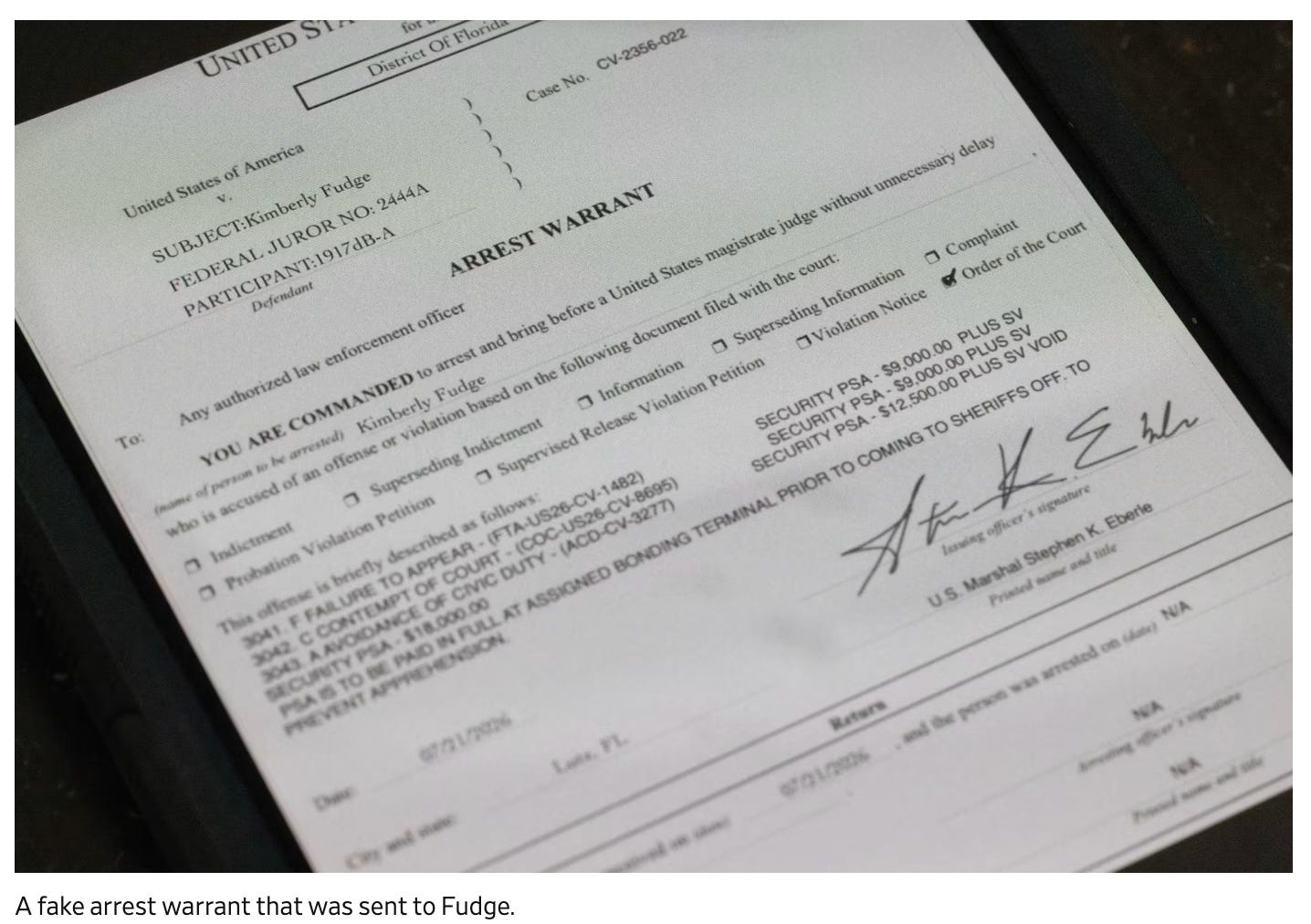
Kimberly Fudge, a finance manager and engineering graduate, spent nearly 10 hours driving alone through Tampa last month, crying, hungry, and handing over cash at cryptocurrency machines — convinced she was about to be arrested for missing jury duty. By the time she walked through her front door, scammers had taken $25,000, according to the Wall Street Journal. The operation involved at least five callers with flawless Florida accents, fake arrest warrants, a spyware-loaded phone that let them monitor her texts and location in real time, and enough psychological pressure to keep a rational person compliant for an entire day. “They basically psychologically kidnap you,” one victim described the tactic online. Americans lost $3.5 billion to impostor scams in 2025 — nearly triple 2020 levels. In Pasco County alone, jury duty scam reports have nearly doubled this year. The reminder from law enforcement is simple: real officers will never call demanding money to avoid arrest. If you get that call, hang up immediately. ⚖️ More here
Speed Cameras, Backlash Spread
Automated speed cameras are now legal in more than two dozen states, with Florida, California, Hawaii, Michigan, and Minnesota among the most recent to join, but a growing driver backlash is accompanying the expansion, according to NPR. Safety advocates point to research showing cameras can cut speeding by 70% or more — a Maryland study found they reduced the likelihood of serious injury by 39%. Critics, including a retired Miami-Dade Sheriff’s Office veteran who received two tickets during school hours when no children were present, argue the programs are revenue grabs rather than genuine safety tools. The Department of Transportation recently removed speed cameras from its list of “Proven Safety Countermeasures,” a move safety advocates say undermines evidence-based policy. The biggest test of the camera debate is looming in Los Angeles, where speed cameras are set to go live in the coming months. 🚙 More here
Retired Chief Subdues Passenger
Retired Minneapolis Police Chief Brian O’Hara found himself back in action at 35,000 feet when he and two off-duty Bergen County sheriff’s deputies helped restrain a belligerent passenger aboard a United Airlines flight from Newark to Fort Lauderdale, according to the New York Post. O’Hara said flight attendants spent nearly 45 minutes professionally attempting to de-escalate the passenger — who had become agitated after being cut off from alcohol — before the man lunged toward the crew. The three law enforcement officers restrained him with flex cuffs and secured him until landing. “No one should take the kind of verbal abuse that they did,” O’Hara said of the flight attendants. “They were absolute professionals trying to keep everybody safe.” O’Hara also used the moment to call for airlines to ensure restraints are readily available and that crew members receive training to use them safely. ✈️ More here
Welcome back!