

9/11 Without the Memory
Twenty-five years after 9/11, more than 100 million Americans were not yet alive when the attacks occurred, and millions more were too young to remember them. The New York Times interviewed nearly three dozen people age 26 and younger about how a generation with no firsthand memory understands an event that fundamentally changed the country. For many, 9/11 is history learned through parents, teachers, museums, social media and popular culture, while their own formative experiences include mass shootings, the pandemic and wars that followed the attacks. Some described a deep respect for the victims, police officers and firefighters who responded that day, while also acknowledging a growing distance from the collective grief experienced by older generations. The result is a generation shaped by the consequences of 9/11 even though they have no memory of the day itself. 🇺🇸 More here
Cartels Escalate Tactics

Mexican drug cartels are increasingly using car bombs, explosive-laden drones and improvised explosive devices against rivals and security forces. The Associated Press reports that a recent car bomb outside a police station in Zacatecas injured 11 people and damaged more than 60 homes, while the state has recorded 23 explosive-related attacks this year. Authorities say the use of explosives has expanded over roughly the past five years, including drones and devices planted along roads. The escalation comes as the United States has designated several Mexican cartels as foreign terrorist organizations, while Mexico has resisted characterizing cartel violence as terrorism. 🔗 More here
Officers Run Toward Gunfire
Three Minneapolis police officers were injured, including two who were shot, while responding to a shooting inside a downtown apartment building that left two victims and the suspected gunman dead. The Associated Press reports officers arrived within two minutes of the initial 911 call and encountered a chaotic scene with limited visibility from a haze inside the building. One officer was shot in the leg, another twice in the abdomen and a third suffered non-gunshot injuries; all were expected to recover. Officers continued responding to the gunfire and locating victims as the incident unfolded. 🔗 More here
Red States Turn on ALPR
The political backlash against automated license plate readers is increasingly coming from law-and-order Republicans. The New York Times reports Texas Gov. Greg Abbott directed police departments to stop using state money for Flock cameras, while Florida Gov. Ron DeSantis ordered the systems removed from state roads and called the technology “out of control.” Police agencies are responding even as they defend ALPR’s crime-fighting value: Jacksonville paused its 150-camera program just a week after highlighting its role in solving crimes, while Dallas is deactivating 321 cameras purchased with state funds. Republican lawmakers in Indiana, Kansas and Tennessee are also pursuing restrictions or greater oversight. Some law enforcement leaders are pushing back, including Florida Sheriff Bill Prummell, who said “criminals are jumping up and down for joy,” while Polk County Sheriff Grady Judd argued the focus should be on ensuring the technology is used appropriately. 🔗 More here
Backlash Hits Retail
The backlash over license plate readers is expanding beyond law enforcement and local government to major retailers. Business Insider reports activists are pressuring Ulta Beauty and Lowe’s to end their use of Flock technology, citing privacy concerns and reported cases of law enforcement officers misusing ALPR data. Ulta says Flock cameras are deployed at fewer than 1% of its more than 1,500 stores and are used to support criminal investigations, particularly organized retail theft; Flock says private customers control data retention and whether information is shared with law enforcement. A petition targeting Ulta had collected more than 13,000 signatures, while a separate campaign against Lowe’s has organized about 10 events. 🔗 More here
Crime Is Down. Disorder Isn't
Murder rates are falling to a 20-year low, but visible disorder remains a concern in many American cities. In a Washington Post opinion discussion, Carine Hajjar talks with Manhattan Institute fellow Heather Mac Donald about the disconnect between falling violent crime and public perceptions of safety. Their conversation covers violent “teen takeovers,” youth crime and urban disorder, possible explanations for the nationwide crime decline, whether President Trump’s policies deserve any credit, and the debate over progressive prosecutors. They also discuss police technology and public trust, along with homelessness, open drug use and involuntary treatment.
Crime Falls in UK, Fear Remains
Crime has fallen substantially in the United Kingdom, but the public largely believes the opposite. Writing in The Conversation, King’s College London public policy professor Bobby Duffy reports that more than eight in ten Britons believe crime has increased in recent years. Eight in ten think mobile phone theft has risen since 2010 and roughly six in ten say the same about vehicle theft and burglary, even though all three have fallen by at least 50%. Murders are down 20% since 2010, yet two-thirds believe they have increased or stayed the same. Duffy attributes the gap partly to people’s tendency to focus on negative information and to a media, social media and political environment that reinforces those perceptions. His research also found the disconnect extends to policing: officer numbers in England and Wales have increased 20% since 2018, but two-thirds of the public believe they have fallen. 🇬🇧 More here
Sweden Fights Back
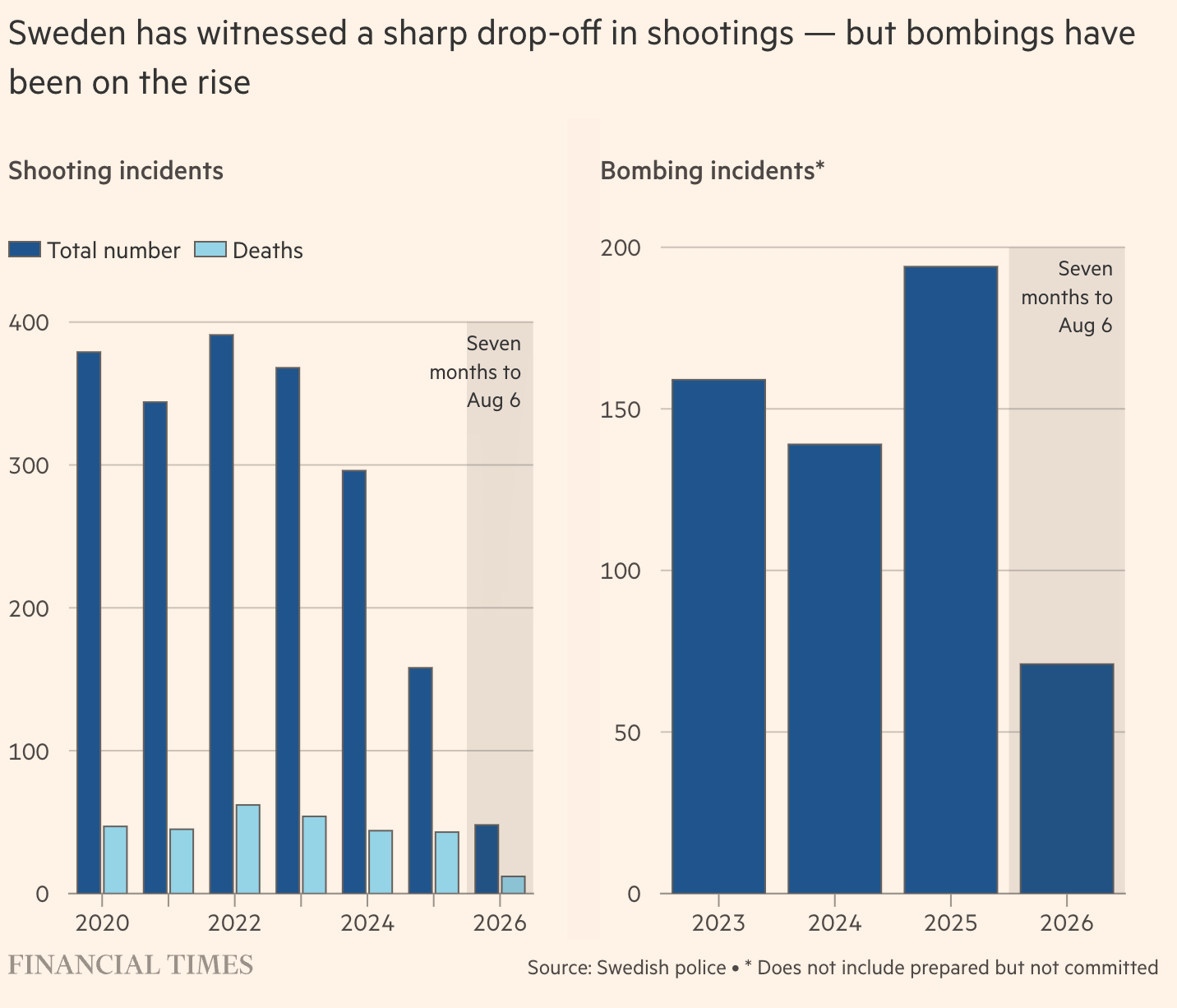
After years of escalating gang violence, shootings in Sweden have fallen sharply. The Financial Times reports Sweden recorded 391 shootings and 62 deaths in 2022, compared with 48 shootings and 12 deaths through Aug. 6 this year—an 80% decline in shootings from the 2022 peak. Police credit no single solution, but point to a shift from investigating shootings individually to nationally coordinating intelligence, identifying connections and intervening earlier to prevent attacks. The government also increased police staffing and resources, expanded wiretap authorities, toughened penalties and worked with foreign governments to arrest gang leaders operating abroad. Significant problems remain: bombings have increased, gangs continue recruiting children as young as 12 through digital platforms, and Sweden’s most notorious gang leader remains at large. Justice Minister Gunnar Strömmer said giving police more officers and better tools “might be the most critical part” of the turnaround. 🇸🇪 More here
Stop Asking Why
In an opinion essay, economist Jennifer Doleac argues that journalists and policymakers should stop obsessing over why crime rates rise or fall. Writing in Probable Causation, Doleac says broad crime trends have many potential causes and there is no clean experiment that can definitively explain major national shifts. More importantly, she argues, understanding exactly what caused the past isn’t necessary to reduce crime in the future. Instead of asking, “Why is crime falling?” she proposes a more useful question: What new ideas do recent crime trends suggest for reducing crime and violence? Communities can then try promising approaches and rigorously test whether they actually work. Her larger point: crime is not something communities simply have to accept—policymakers and practitioners have the ability to intervene and shape what happens next. 📉 Essay here
K-9 on the Mend
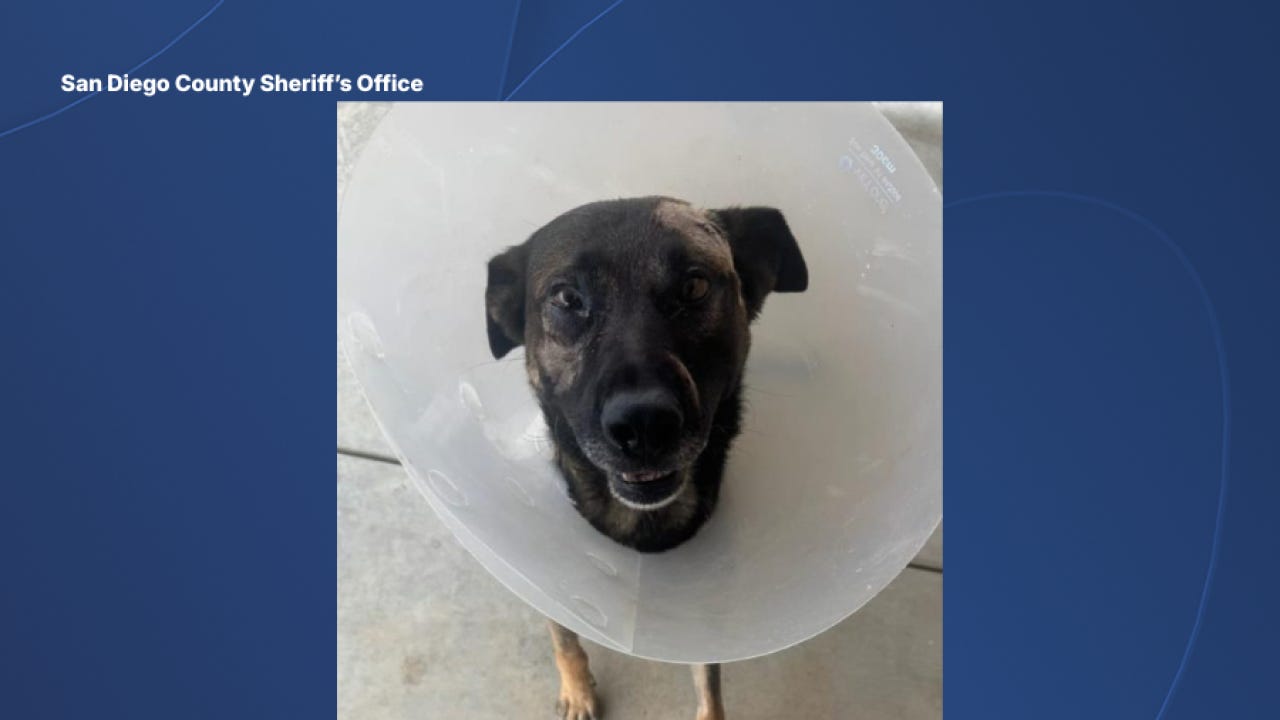
A San Diego County Sheriff’s K-9 is recovering after being stabbed several times while helping police arrest a burglary suspect. Nike, a 6-year-old Belgian Malinois, was deployed after police said the suspect was swinging a large stick, throwing objects and threatening officers. Authorities said the suspect stabbed Nike in the face several times before officers and deputies took him into custody. Nike was rushed to a veterinary hospital and treated for five facial lacerations and two puncture wounds. The suspect was booked on charges including injuring a working dog, resisting arrest and second-degree burglary. 🐶 More here