

Shootings Near Schools
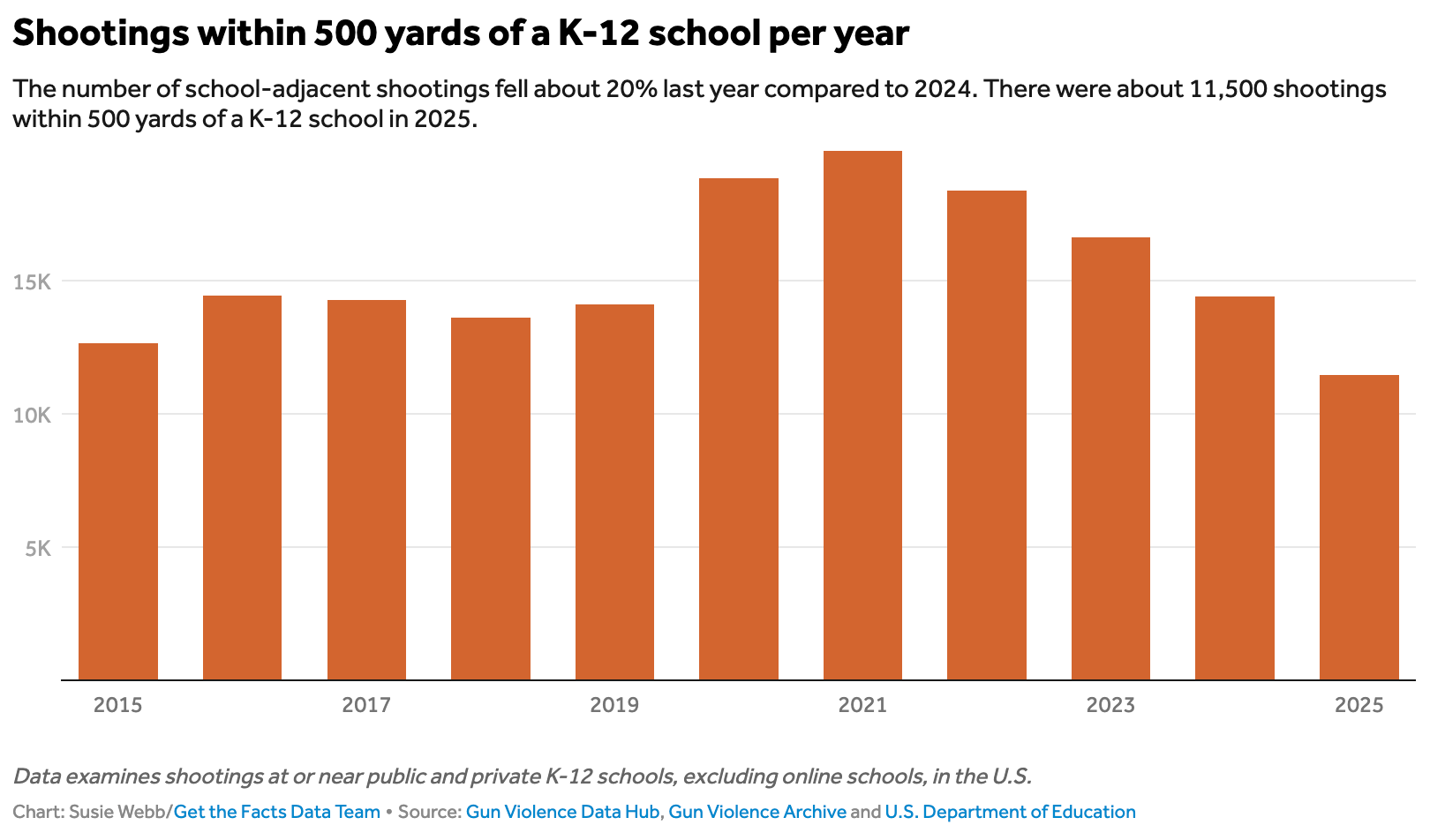
New data shows there were approximately 11,500 shootings within 500 yards of U.S. K–12 schools in 2025—an average of 31 incidents per day—impacting more than 10,000 schools nationwide, or about 8% of all schools. Over the past decade, roughly 26% of schools have experienced at least one nearby shooting, with about 4,500 people killed by gunfire near schools last year. While incidents have declined from pandemic-era peaks, the data underscores how frequently gun violence still occurs in close proximity to schools across both urban and rural communities. 🔗 More here
U.S. Guns Fuel Cartels
Authorities estimate that between 500,000 and as many as one million firearms are trafficked from the United States into Mexico each year, with about 80% of weapons recovered at crime scenes in Mexico traced back to U.S. sources. U.S. enforcement efforts have intercepted a small portion of that flow, with the ATF reporting just over 4,300 firearms seized over the past 14 months despite the scale of trafficking. The pipeline often begins with legal purchases at U.S. gun stores, shows, and private sales, then moves through networks using straw buyers, online marketplaces, and smuggling methods such as hidden vehicle compartments, private planes, and boats, making the supply chain difficult to disrupt. 🔗 More here
Older Drivers Debate
There is no national standard for older driver licensing, with each state setting its own renewal rules and testing requirements. Data shows older Americans are driving more than ever, and while their crash rates have declined over the past 25 years, risk increases again after age 80; by comparison, teenagers and drivers in their 20s have the highest crash rates overall. A study cited in the report, based on more than 19 million drivers across 13 states over two decades, found higher crash rates among drivers ages 65–74 in states that loosened renewal requirements, highlighting mixed evidence as states balance safety and mobility. 🚙 More here
Threats to Lawmakers Rising
Threats against members of Congress continue to increase, with U.S. Capitol Police investigating nearly 15,000 concerning statements and threats last year—a 58% increase over the prior year—according to . Capitol Police Chief Michael Sullivan told lawmakers the department is on pace to exceed that number this year, calling the situation a growing “threat environment.” The agency is seeking its first-ever budget exceeding $1 billion as its mission expands, including providing security support for lawmakers beyond Washington, D.C., through mutual aid agreements in all 50 states. 🔗 More here
New Podcast Live
In this episode, Sheriff Dennis Lemma of the Seminole County Sheriff’s Office joins the podcast for a wide-ranging conversation about leadership and service. He reflects on rising through the ranks, from correctional officer to sheriff, and shares how that journey has shaped the way he leads today. Sheriff Lemma also discusses the opioid epidemic, the importance of addressing root causes, and why he believes mental health is the next major challenge public safety must confront.
Judge vs. Police on Release
A Las Vegas judge ordered the release of a defendant with 35 prior arrests to an electronic monitoring program, despite police declining to place him in the program over safety concerns. Las Vegas Metro police said the defendant’s history includes prior bench warrants, failures to appear, and violations of the monitoring program, and argued Nevada law gives the sheriff authority to deny release if it poses “an unreasonable risk to public safety.” Sheriff Kevin McMahill said, “The safety of our officers is paramount… the safety of the public is key,” adding his office “will not violate the law… and let out people who he deems to be dangerous.” 🔗 More here
UK Launches Police AI Center
The UK is launching a new £115 million ($145 million USD) national center, “Police.AI,” to scale the use of artificial intelligence across policing, according to . Officials say the effort could free up the equivalent of 3,000 officers by automating administrative work, speeding investigations, and expanding tools like facial recognition and call transcription. The center will standardize, test, and deploy AI tools across all 43 police forces in England and Wales while also creating a public-facing registry to increase transparency and public trust. 🇬🇧 More here
Drones and Crime Decline
San Francisco police report a sustained decline in crime and credit new technology, including drones and license plate readers, as contributing factors, with drones assisting in more than 1,000 arrests since their deployment in April 2024. The department currently operates 80 drones and 400 license plate readers as part of its Real-Time Investigation Center, which supports live monitoring and response to incidents. Car break-ins previously peaked at more than 28,000 reported cases in 2017, and the drone program was approved by voters in 2024 with 54% support. 📉 More here
The Origin of TASER
It starts with two brothers who fought so much as kids their parents gave them oversized boxing gloves just to manage the chaos — the same grit that later kept their company alive through moments that would have ended most startups. In this episode of Boldly Go, Tom and Rick Smith share the untold early days of TASER, from risky product tests (including the original pool demo) to near-arrest at LAX, fleeing Italy, and discovering a last-minute legal loophole that moved the company to Mexico and saved it. They also reflect on the moment their father told them they had “one more shot” — a line that defined what came next. And yes, we get into one of the most asked questions: can a TASER take down a bull — and what happens when it gets back up?