

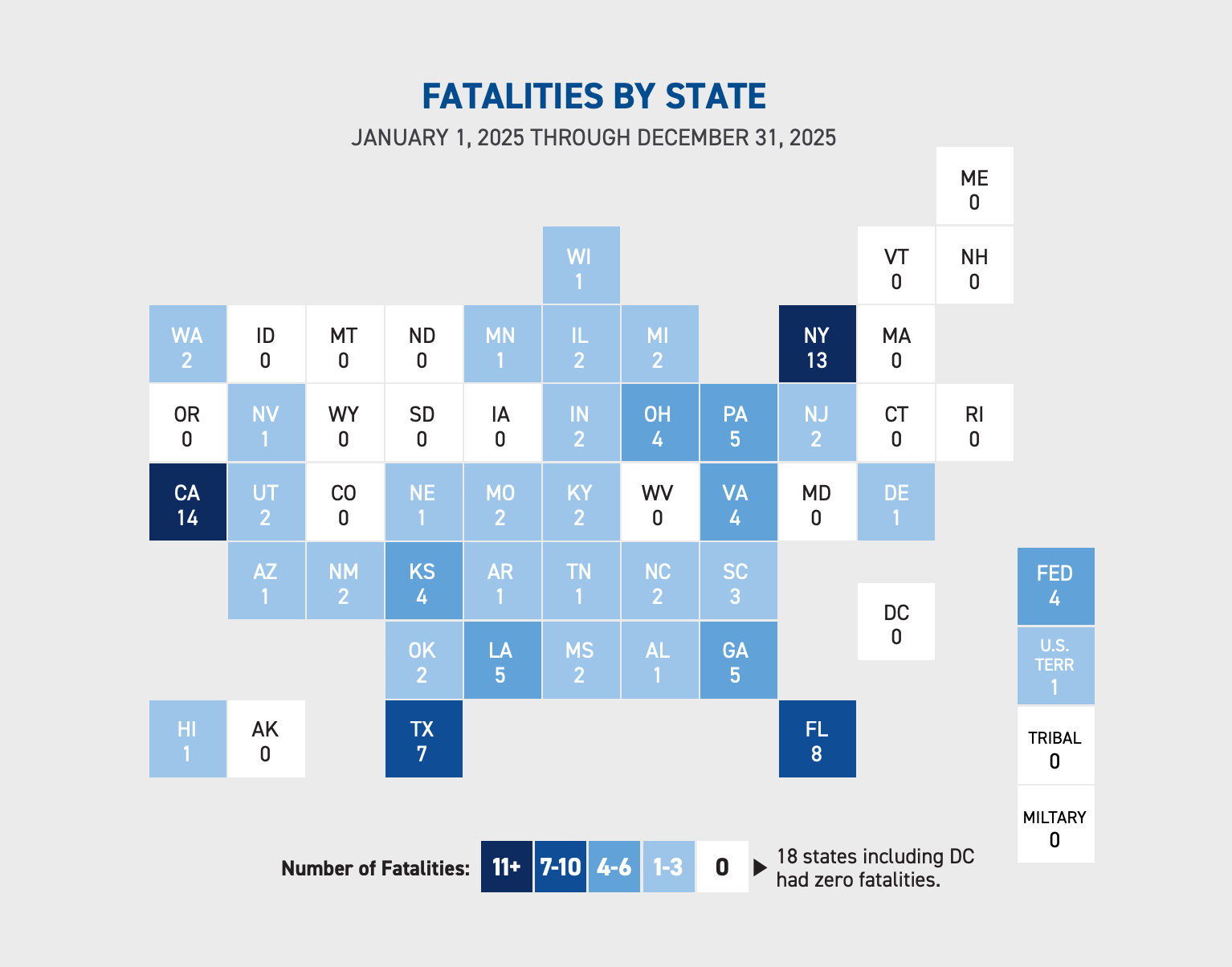
Officer Deaths Hit 80-Year Low
Law enforcement line-of-duty deaths nationwide fell to a near-historic low in 2025, reaching levels not seen since 1943. According to the National Law Enforcement Officers Memorial Fund (NLEOMF), 111 officers died in the line of duty last year, representing a 25% decrease from the 148 fatalities recorded in 2024. The report highlights significant declines across all major categories: firearms-related deaths dropped 15% to 44 incidents, traffic-related fatalities fell 23% to 34, and health-related or “other” causes saw a 37% decrease. NLEOMF officials attribute this downward trend to the adoption of better safety protocols and a heightened focus on officer wellness, marking a significant milestone in the effort to protect those serving in federal, state, and local agencies. 🚨 Full report here
Targeted Police Ambush
A Greenville, South Carolina, police officer is recovering after being shot multiple times in a targeted, “ambush-style” attack while sitting in his patrol vehicle early Sunday morning. The incident, which ended in a fatal shootout with the suspect, underscores a dangerous national trend: unprovoked attacks on law enforcement are remaining at historically high levels. According to recent data from the Fraternal Order of Police, ambush-style attacks have surged in the opening weeks of 2026, contributing to a broader “recruitment and retention crisis” as agencies struggle to protect officers from spontaneous violence. This latest assault follows a series of high-profile federal disruptions of extremist plots targeting law enforcement, signaling a high-stakes year for domestic security and police safety across the country. 🔗 More here
Tragedy Amid Federal Surge
The fatal shooting of 37-year-old Renee Good by an ICE agent in Minneapolis has escalated tensions just days after the Trump administration deployed 2,000 federal agents to the area. According to CBS News, the video shows the shooting occurred as Good pulled her SUV forward while agents attempted to open her door, an incident DHS Secretary Kristi Noem characterized as “domestic terrorism” and an act of self-defense. Minneapolis Police Chief Brian O’Hara, while calling the outcome “predictable” and urging peace, confirmed his officers were not involved in the shooting but are now facing violence from protesters at the scene. The FBI has opened an investigation into the incident to determine the facts as local law enforcement struggles to maintain order amid the unrest. 🔗 More here
Local Federal Relationships Crack
A series of fatal shootings involving federal immigration agents has severely strained the traditional partnership between local, state, and federal law enforcement. While agencies typically coordinate on high-stakes investigations, officials in cities like Minneapolis and Portland report being excluded from recent shooting inquiries, leading to public clashes between local leaders and the Department of Homeland Security. DHS Secretary Kristi Noem has defended the federal actions as necessary for public safety and criticized state oversight, while local authorities warn that this breakdown in communication and “toxic” federal branding hinders the ability to fight crime and maintain community trust. This growing fissure, according to The New York Times, represents a significant shift in American policing, moving into uncharted territory as states and the federal government battle over jurisdiction and enforcement tactics. 🔗 More here
New Briefing Room Podcast
In this episode, I sit down with Wichita Police Chief Joe Sullivan to discuss his transition from a 30+ year career with the Philadelphia Police Department to leading one of the Midwest’s busiest police departments. Chief Sullivan shares his philosophy on data-driven policing, including a reimagined CompStat process, focused shooter reviews, and strong partnerships with federal and local agencies to reduce gun violence. The conversation also explores recruitment and retention strategies, the role of technology like real-time crime centers and drones as first responders, and the importance of telling policing’s story through initiatives like “Well Done Wednesday.”
States to Limit Federal Immigration
Following the fatal shooting of Renée Good in Minneapolis, a growing number of Democratic-led states are advancing legislation to curb federal immigration enforcement within their borders. According to Politico, Lawmakers in states like California, New York, New Jersey, and Illinois are proposing measures that would prohibit federal agents from wearing masks during operations and restrict the sharing of data from schools and hospitals with federal authorities. While the White House maintains that these agents are performing necessary, high-risk duties to enforce federal law, state leaders argue that uncoordinated federal actions undermine local public safety and community trust. This mounting legislative push highlights a deepening constitutional tug-of-war over state sovereignty and the limits of federal enforcement power in local jurisdictions. 🔗 More here
AI Audits Shift Police Behavior
A first-of-its-kind study published in the journal Criminology reveals that artificial intelligence can measurably improve police professionalism. The randomized controlled trials, involving over 189,000 body-worn camera videos at the Aurora Police Department and Richland County Sheriff’s Department, found that AI-led auditing—which transcribes and scores officer language—led to a 57% reduction in “substandard” interactions in one agency and an 81.8% increase in “highly professional” conduct in the other. While some officers expressed concern that the technology creates a “fishing expedition” for minor policy breaches, researchers noted that providing direct feedback successfully encouraged officers to proactively meet higher standards. As 95% of body camera footage currently goes unreviewed due to resource constraints, the study suggests AI could transform passive recording into an active tool for accountability and training. 📖 Full article here
Tampa Deploys AI Policing
The Tampa Police Department has launched a suite of AI-powered tools designed to enhance officer response times and de-escalate high-pressure situations. According to Fox 13 News, the new technology includes “Prepared 911,” which allows dispatchers to receive live video feeds from callers’ smartphones, and “Axon Assistant,” a body-worn camera feature that provides real-time translation for over 50 languages. Additionally, officers now have access to “Policy Chat,” an AI tool that allows them to instantly look up department procedures via a voice-activated app. Chief Lee Bercaw emphasized that while these tools are intended to act as a “force multiplier” by providing real-time intelligence and removing language barriers, they are designed to support—not replace—human decision-making in the field. 💻 More here
Cincinnati Violence Hits Low
Cincinnati gun violence plummeted to a three-year low in 2025, marking the city’s least deadly year for shootings since the pandemic. According to Fox19, total shooting incidents dropped to 241, a significant decrease from the 313 recorded in 2023. While major neighborhoods like Over-the-Rhine and the West End saw notable improvements, the data reveals a persistent challenge: juvenile shooting incidents remained nearly stagnant, and the total number of gun-related fatalities stayed flat year-over-year. These statistics suggest that while overall enforcement and community safety initiatives are successfully reducing the total volume of street violence, targeted intervention for youth remains a critical necessity for maintaining the city’s downward crime trajectory. 📉 More here
LA Homicides Record Low
Los Angeles recorded 230 homicides in 2025, marking the city’s fewest killings since 1966 and its lowest per capita murder rate since 1959. According to the Los Angeles Times, this 19% year-over-year decline mirrors a national trend of falling violent crime in major cities like Chicago and New York. While the drop is significant, the total count remains a subject of debate; under a new federal reporting system that includes “vehicular homicides” such as DUI-related deaths, the city’s total rises to 313. Law enforcement officials attribute the progress to targeted enforcement against repeat offenders and successful community safety partnerships, even as the LAPD continues to face staffing shortages and budget constraints. 📊 More here
New VSP Colonel
Virginia Governor-elect Abigail Spanberger has appointed Jeffrey Katz, a former Chesterfield County police chief with federal law enforcement experience, as the next superintendent of the Virginia State Police. According to WWBT, Katz led the Chesterfield force for six years before joining the FBI in 2024 to train senior law enforcement executives. Katz, a former president of the Virginia Association of Chiefs of Police, will succeed Colonel Matthew Hanley as part of a senior leadership team Spanberger says is focused on addressing the Commonwealth’s challenges with practical solutions. The selection marks a high-profile move by the incoming administration to place a veteran local commander with national-level expertise at the helm of Virginia’s primary state law enforcement agency. 👮♂️ More here
Briefing Room Podcast
In this episode of The Briefing Room, I sit down with Redmond (WA) Police Chief Darrell Lowe for an in-depth conversation about leadership, accountability, and the future of public safety technology. Chief Lowe reflects on his journey from growing up in Los Angeles to joining the Santa Monica Police Department and later leading the Redmond, Washington, Police Department, discussing how early career “knucklehead” mistakes shaped his approach to leadership. He shares insights on race and policing, the importance of professional involvement beyond one’s own department, and Redmond’s pioneering Drone-as-First-Responder (DFR) program.