

Pilot and Trooper Killed
Arizona authorities have identified Pilot Robert Skankey, 61, and Trooper-Paramedic Hunter Bennett, 28, as the two crew members killed when their Department of Public Safety (DPS) helicopter crashed. The crew of Ranger 52 was responding to a chaotic domestic violence call in Flagstaff, where a 50-year-old suspect had opened fire on officers with a semiautomatic rifle from a residential rooftop. The crash remains under investigation by the National Transportation Safety Board. 🖤💙 More here
States Restricting ICE Cooperation
Multiple states are moving to prohibit or limit local law enforcement participation in federal immigration enforcement through 287(g) agreements, which allow local agencies to assist federal authorities in identifying and detaining people suspected of being in the country illegally. Maryland lawmakers have passed legislation requiring local sheriffs to end such agreements, while several other states have already enacted restrictions or are considering similar measures. Supporters argue the bans prevent local police from being drawn into federal immigration enforcement, while federal officials contend cooperation improves public safety and reduces arrests conducted on neighborhood streets. Since early 2025, agreements between federal authorities and local agencies have expanded rapidly nationwide, intensifying debates over states’ roles in immigration enforcement and prompting additional legislative efforts to further limit cooperation or restrict data sharing with federal immigration authorities. 🔗 More here
Immigration Oversight Strategy
Austin Police Chief Lisa Davis has detailed a new oversight protocol intended to balance the requirements of state law with the necessity of community trust. While emphasizing that the Austin Police Department does not proactively enforce federal immigration law or consider status when responding to calls, Davis noted that the department must comply with Texas Senate Bill 4, which prohibits local policies that limit cooperation with federal immigration authorities. To navigate these complex legal boundaries, the department now requires that a duty commander be notified whenever federal officials request assistance with administrative warrants. This senior ranking member makes the final determination on whether such assistance is “reasonable or necessary” after reviewing the totality of the circumstances. This strategic layer of accountability is designed to prevent unnecessary detentions while ensuring that the department’s critically limited resources—currently facing severe staffing shortages—remain focused on emergency response and the city’s most urgent safety needs. 📰 Op-ed here
Milwaukee Bans Facial Recognition
Following a contentious public hearing, Milwaukee Police Chief Jeffrey Norman announced a voluntary department-wide ban on the use and acquisition of facial recognition technology (FRT), effective immediately. The decision halts a proposed agreement with the data company Biometrica, which would have traded 2.5 million police mug shots for software licenses—a deal that drew over three hours of public testimony from residents and advocacy groups concerned about high misidentification rates among people of color and the potential for data misuse. While Chief Norman acknowledged FRT as a “useful technology to assist in generating leads,” he stated that maintaining public trust is “far more valuable” than the investigative benefits of the tool. However, the Milwaukee Police Association expressed deep disappointment, arguing that removing FRT—coupled with new restrictions on vehicle pursuits—unnecessarily limits law enforcement’s ability to solve violent crimes and protect the public. More here
New MCSA President

Last week, Pinellas County (FL) Sheriff Bob Gualtieri was sworn in as President of the Major County Sheriffs of America (MCSA) during the association's Policy Conference in Washington, DC. Senator Rick Scott administered the oath of office to Gualtieri, who will lead the professional association for a two-year term representing the nation's largest sheriff's offices—those serving jurisdictions with populations of 400,000 or more. Gualtieri stated that the MCSA is well-positioned to impact national public safety through advocacy, policy priorities, and the collective expertise of its member sheriffs, who together serve a combined population of over 120 million citizens. 🔗 More here
Tucson Police Chief Retires
Tucson Police Chief Chad Kasmar has announced his retirement from law enforcement after 25 years of service to accept a role as deputy county administrator for Pima County beginning March 1, 2026. During his tenure as chief since 2021, Kasmar was credited with professionalizing the force and expanding the Community Service Officer program under the city’s Safe City Initiative. To ensure a smooth transition, City Manager Tim Thomure has appointed Deputy Chief Monica Prieto, a 26-year department veteran and Tucson native, to take over the leadership role. Prieto, who has served as the department’s number-two for the last three years, has stated that her primary goals include maintaining community trust and officer safety while continuing the collaborative safety strategies established by her predecessor. 🔗 More here
I’m Going to Jackson
Mayor John Horhn has nominated RaShall Brackney, a former Pittsburgh police commander with a Ph.D. in instructional management and leadership, to serve as the next chief of the Jackson Police Department. Brackney, who would be the third woman to lead the department, was selected following a months-long recruitment process triggered by the retirement of Joseph Wade in September 2025. Her career includes previous roles as police chief in Charlottesville, Virginia, and at George Washington University, as well as academic work at George Mason University focusing on police legitimacy and transparency. If confirmed by the Jackson City Council, Brackney will take over a department currently celebrating a decline in homicides to pre-pandemic levels while navigating internal shifts, including the recent departure of an assistant chief due to alleged political pressures. 🔗 More here
Major Cities Violent Crime Declines
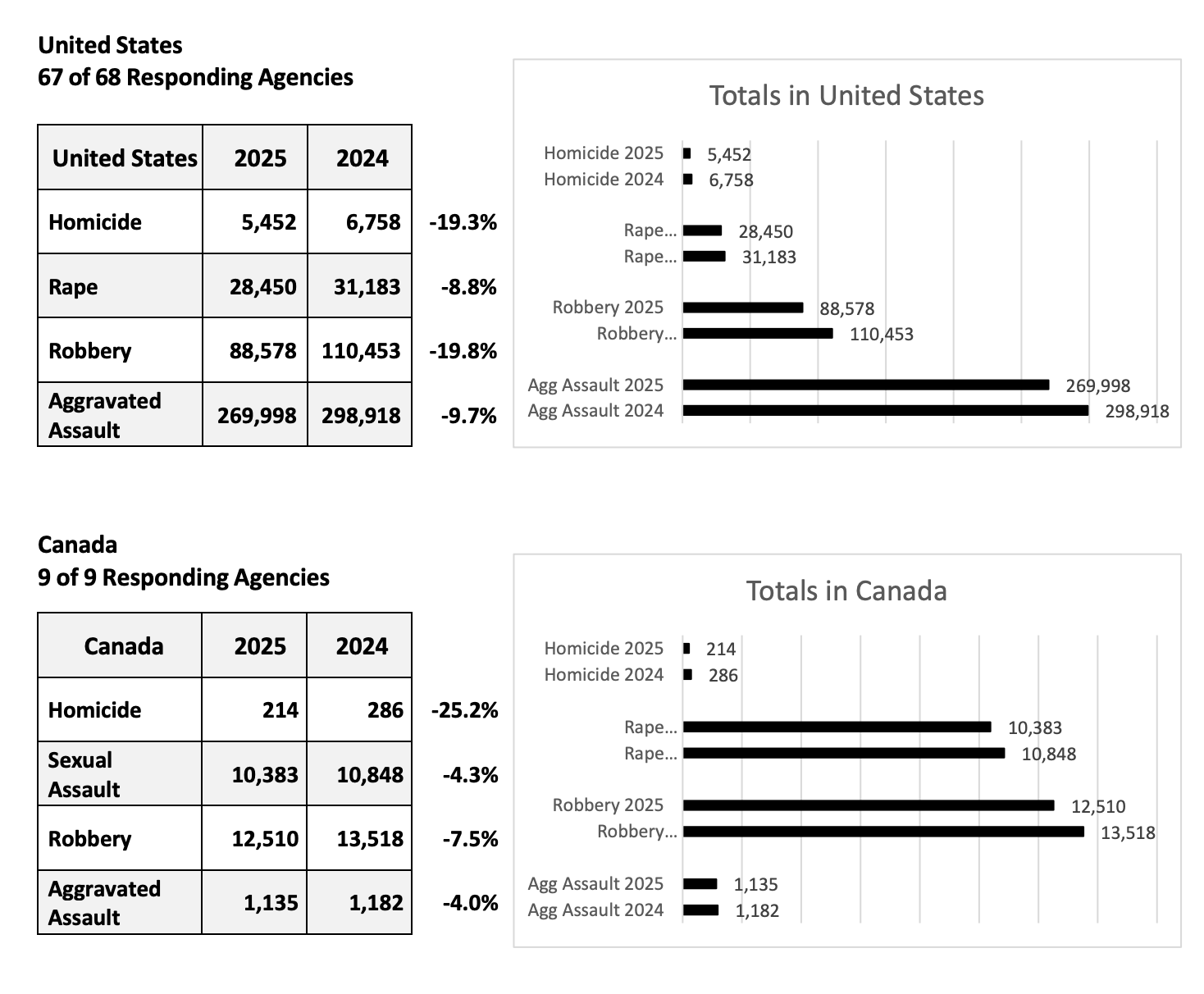
Preliminary year-end data from the Major Cities Chiefs Association reveals a significant downward trend in violent crime across the United States and Canada in 2025. In the US, homicides plummeted by 19.3%, falling from 6,758 to 5,452, while robberies saw a nearly identical drop of 19.8%. According to the MCCA survey, which includes data from 67 of 68 responding U.S. agencies, other violent categories also experienced decreases, with rape down 8.8% and aggravated assault dropping by 9.7%. Major metropolitan areas saw substantial improvements, with Chicago recording 170 fewer homicides and New York City seeing a 27% reduction in homicides alongside a decrease in overall aggravated assaults. Canadian cities reflected this positive shift as well, reporting a 25.2% decrease in homicides and a 7.5% reduction in robberies. 📉 MCCA report here
Fully Automatic Handgun Used

Early Sunday morning, Fall River (MA) police fatally shot 40-year-old Nigel Vaughn after he allegedly opened fire on officers with a Glock handgun modified with a “switch” to make it fully automatic. According to Bristol County District Attorney Thomas Quinn, the encounter began following a 911 call regarding an armed man in an SUV; when officers attempted a pat-down, Vaughn allegedly resisted violently and produced the modified weapon during the ensuing struggle. Vaughn allegedly fired multiple rounds at the officers, striking one in the elbow and another in his bullet-resistant vest before police returned fire. All involved officers have been discharged from the hospital, while Vaughn, a previously convicted gang member who had served a lengthy prison sentence for a 2005 double shooting, was pronounced dead shortly after arriving at a local medical center. 🔗 More here
Crisis Teams in Crisis
Mobile crisis response teams, which dispatch mental-health professionals instead of police to psychiatric emergencies, have significantly reduced police time spent on mental-health calls — nearly 80% in Bozeman, Montana — while helping people stay safely at home and avoiding unnecessary ER visits and jail bookings. Despite rapid national expansion to roughly 1,800 teams, many programs face closure because funding is inconsistent; Medicaid and private insurers often reimburse only portions of the service, leaving teams dependent on grants and short-term funding, creating instability for communities trying to build alternatives to police-led crisis response. 🔗 More here