

Mosque Shooting Timeline
The San Diego Police Department released a preliminary timeline Friday of the Islamic Center of San Diego shooting that killed three men — Amin Abdullah, Mansour Kaziha, and Nadir Awad — with the two teenage shooters found dead from apparent self-inflicted gunshot wounds nearby, according to NBC 7 San Diego. Police addressed questions about whether staffing shortages played a role, stating that once the call was elevated to Priority 1, officers were en route within approximately five minutes, and when reports of an active shooter came in, a countywide Priority 0 response put officers on scene within four minutes. SDPD acknowledged staffing will be part of its ongoing review. Both SDPD and the FBI urged the public and media to stop sharing unverified photos of the suspects circulating online, noting that incorrect images had already led to at least one wrongful identification. 🔗 More here
Streets Barricaded Over Violence

Frustrated by repeated shootings tied to prostitution and human trafficking activity along Seattle’s Aurora Avenue, North Seattle residents have taken matters into their own hands — hauling in large metal planters, dirt, and gravel to partially block residential side streets used as escape routes by gunmen, according to KOMO News. The self-imposed barricades follow a weekend shootout near Aurora Avenue and North 98th Street in which police recovered roughly 40 shell casings, with bullets striking nearby buildings, vehicles, and a fourth-floor apartment — and a separate incident where a round stopped near the bassinet of a 6-week-old baby. Critics warn the makeshift barriers could delay ambulances and fire crews, and the city requires permits for any public right-of-way closures. Seattle police said they are increasing late-night patrols and deploying the department’s Gun Violence Reduction Unit. 🔗 More here
Academia Is Failing Police
University of Pennsylvania criminologist Jerry Ratcliffe argues in a newly published paper that mainstream academia has become actively hostile to policing scholarship — and that the consequences will ultimately harm the communities police serve. Writing in Evidence Base, Ratcliffe documents a pattern of ideological suppression within criminology and criminal justice departments: policing scholars shouted down in faculty meetings, job offers rescinded over past law enforcement careers, personal health information leaked to doxxing websites, and graduate students discouraged from pursuing police research. He argues that a 30-to-1 liberal-to-conservative ratio in the field, combined with the rise of “activist-scholars,” has driven quality policing researchers out of academia — leaving departments less equipped to provide the evidence-based reform and critical oversight that law enforcement actually needs. His proposed solution is a significant expansion of “pracademics” — current or former police officers with scientific training who work inside departments, bridge the gap between research and practice, and can deliver evidence-based insights without depending on an increasingly hostile university system. Ratcliffe warns that without intervention, police departments will receive less effective academic scrutiny, reform efforts will slow, and government institutions will see little value in funding policing research at all. 🔗 Paper here
Police Staffing Rebounds
A new national survey from the Police Executive Research Forum finds that sworn officer staffing has rebounded to its 2022 level after years of post-pandemic decline, driven by a 17.6% increase in hiring in 2025 — 40% more than in 2021, according to PERF. Resignations have stabilized and remain 15% below their 2021 peak, though retirements rose 16% in 2025. The survey, covering 197 agencies collectively employing more than 138,000 sworn officers, shows agencies have employed a range of strategies to boost hiring including signing bonuses, lowered educational requirements, and streamlined hiring processes. Despite the progress, PERF Executive Director Chuck Wexler noted that staffing remains below pre-pandemic 2020 levels, chiefs continue to rely heavily on overtime to fill gaps, and competition from federal agencies offering signing bonuses as high as $75,000 has made recruiting qualified candidates increasingly difficult. 👮♂️ PERF report here
Operation Red Card
Bodycam Footage Released
Fort Worth Police Chief Eddie Garcia released body camera footage Friday detailing two fatal officer-involved shootings that occurred hours apart early May 16, according to NBC 5 Dallas-Fort Worth. In the first incident, officers responded to multiple 911 calls about gunfire at a house party and shot and killed 25-year-old Emmett Mayo, a known gang member who ran toward officers with an illegally possessed and modified Glock switch-equipped firearm — making it fully automatic. More than 30 shell casings were recovered at the scene. Hours later, while officers were still investigating, a white SUV repeatedly charged at them, leading to a chase and ultimately the fatal shooting of 29-year-old Jorge Contreras, who Garcia said had a history of mental illness. An officer was injured in the incidents. 🔗 More here
Record Low Murder Rate
Crime data analyst Jeff Asher writes in his Jeff-alytics newsletter that 2026 will likely set a new record for the lowest U.S. murder rate ever recorded by the FBI — building on what was already a historic low in 2025. Data through April from a sample of 30 major cities shows murders down 19.1% compared to the same period last year, consistent with figures from the Gun Violence Archive, the Real-Time Crime Index, and the Major Cities Chiefs Association, all pointing to another significant decline. Asher projects that even a modest 10% annual drop would push the murder rate below 4 per 100,000 — the lowest since the FBI began using its current methodology in 1958. While the pace of decline appears to be gradually slowing from the record drops seen in 2024 and 2025, Asher says a reversal is unlikely, noting the country is “so far into uncharted murder reduction waters” that predicting what comes next remains difficult. 📉 Jeff-alytics Substack
Why Officers Don’t Seek Help
Research summarized in the new issue of Applied Police Briefings finds that stigma, fear of career consequences, and departmental mistrust remain the primary barriers to officers seeking mental health support. Of 297 sworn and civilian personnel surveyed at a large metropolitan department, only about one-third reported using mental health services — though that rate exceeds national averages. Civilian staff were nearly five times more likely to seek services than sworn officers. Among those not using resources, 44% said they lacked time, 20% cited departmental mistrust, and nearly 10% feared disciplinary repercussions or damage to their reputation. Researchers recommend that agencies reduce stigma through strong leadership, ensure confidentiality policies are clearly communicated, offer both internal and external services, and take a preventive rather than crisis-driven approach to officer wellness — extending support to family members as well. 🔗 More here
Santa Fe Names Interim Chief
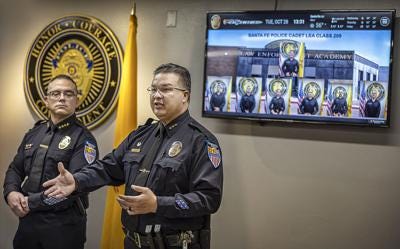
Deputy Chief Ben Valdez has been named Santa Fe’s next interim police chief, taking over June 4 following the retirement of interim Chief Thomas Grundler, according to the Santa Fe New Mexican. Valdez, a U.S. Marine Corps veteran who received a Purple Heart after being wounded in Fallujah, joined the department in 2005 and rose to deputy chief in 2018. He has been credited with reducing the department’s officer vacancy rate to near zero and was previously assigned to fix systemic problems in the department’s evidence room following a high-profile evidence loss in a murder case. Mayor Michael Garcia has directed the interim city manager to begin a search for a permanent chief, with the position to be advertised next week. Two captains — Amanda Montaño and Lawrence Barnett — were also promoted to deputy chief as part of the leadership transition. 🔗 More here
Cyclist Deaths Up 86%
A series of violent incidents between drivers and cyclists this spring — including a Florida shooting, a California road rage attack, and a Georgia SUV assault — reflects a troubling national trend, according to USA Today. Bicyclist fatalities have risen 86% since 2010, with 1,103 cyclists killed in traffic crashes in 2024 alone, driven in part by more cyclists on the road, wider roads that encourage higher speeds, and increased reckless driving since the pandemic. Experts note that road rage runs in both directions — drivers frustrated by slower cyclists and cyclists who feel threatened by vehicles — but cyclists bear a fundamentally greater physical risk in any conflict. Infrastructure gaps compound the problem: bike lanes are frequently too narrow, obstructed by parked cars, and unprotected from drifting traffic. 🚴🏻♀️ More here
I live in a University Town. I also spent decades in policing, and I enjoy biking recreationally. While serving as Chief, we had local bicyclist groups lobbying for more access to public roadway space. I love the idea, but in practice, I have always approached this issue with great caution because I have witnessed firsthand the outcomes of vehicle-versus-bicycle collisions. The bicyclist always loses.
What has always concerned me is that many cities are redesigning roads to force greater interaction among cars, bicycles, and pedestrians, at the exact same time that distracted driving has exploded because of smartphones and in-vehicle technology. We are increasing shared spaces and conflict points, all in an environment where there is essentially a cell phone in every car.
That does not mean drivers should not be accountable. They absolutely should. But I also think we need to be honest about human behavior, reaction time, attention limitations, and risk. Simply demanding that drivers “pay more attention” does not magically eliminate physics, distraction, or the reality of modern traffic environments.
I am not convinced these increases are always driven primarily by road rage or anti-cyclist attitudes. In many cases, I suspect they are the predictable outcome of combining more vulnerable road users, more complex roadway interactions, larger vehicles, faster traffic, and unprecedented levels of distraction.
We should absolutely work toward safer streets, but that discussion needs to remain grounded in systems thinking and reality, not ideology. Because, regardless of who is legally right, a bicycle still loses against a car every single time. I commend those who take to the cycle lanes, but personally, I'll stick to the trails on my bike, and use my car when I'm on the road!