

Leading Through Fractured Trust
On The Briefing Room podcast, Hennepin County Sheriff Dawanna Witt joins Mike Wagers to discuss leading a major law enforcement agency when public trust is fractured. Witt reflects on her unlikely path from growing up distrustful of police to becoming Hennepin County’s first woman and first person of color elected sheriff, along with lessons from the aftermath of George Floyd’s murder, major trials and immigration enforcement. She discusses why leaders must “define so you’re not defending,” the importance of representation and different perspectives in policing, innovative jail programming, and her belief that rebuilding trust requires communication, accountability, authenticity and consistently showing up for the community. (Click above).
America’s Luddite Summer
The Wall Street Journal reports that a growing backlash against artificial intelligence is taking shape across the country, with Flock license plate readers and massive data centers becoming tangible symbols of broader unease about where technology is taking society. Opposition is crossing traditional political lines: activists fear AI could eliminate jobs or pose larger societal risks, communities are fighting data centers over electricity and water use, and privacy advocates are protesting automated license plate readers. Flock cameras have drawn particular scrutiny following reports of misuse, even as the company and law enforcement defend the technology for helping fight crime; amid the pressure, Flock announced new safeguards governing access to license-plate data. The grassroots resistance is drawing comparisons to the early Tea Party movement, with disparate groups finding common cause around a fundamental question: how much say citizens and communities should have over the rapidly expanding role of AI and the technologies built around it. 🤖 More here
IACP Statement on ALPRs
As controversy over license plate reader technology intensifies nationally, the International Association of Chiefs of Police has released a formal policy statement outlining the principles it believes should govern responsible use of automated license plate recognition systems. The IACP reaffirmed its support for ALPR as a legitimate public safety tool — capable of locating vehicles connected to violent crimes, generating investigative leads, and improving officer safety — while making clear that support is conditional on strong safeguards. Key requirements in the statement include limiting access to trained, authorized personnel; prohibiting personal, political, retaliatory, or discriminatory use; treating every ALPR alert as an investigative lead rather than conclusive evidence; maintaining tamper-resistant audit records; purging data promptly once it no longer serves an authorized purpose; and applying accountability measures — including criminal charges when warranted — for misuse. The IACP has also convened a working group of law enforcement leaders and subject matter experts to develop guidance and best practices, and launched a dedicated ALPR Resource Page as a central hub for agencies navigating the technology’s evolving policy landscape. 🔗 More here
FOP Slams Flock
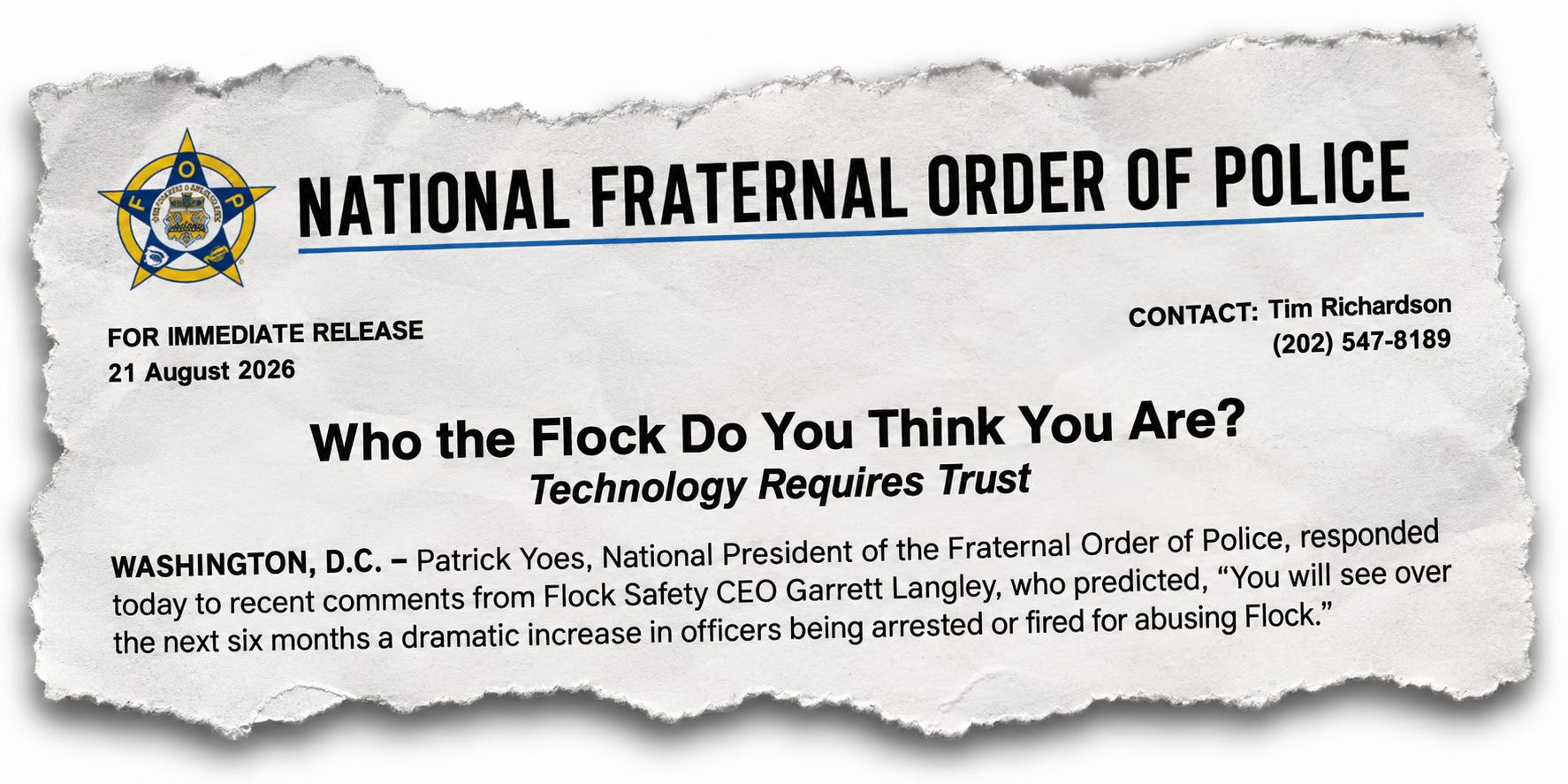
The National Fraternal Order of Police is pushing back hard after Flock Safety CEO Garrett Langley predicted “a dramatic increase in officers being arrested or fired for abusing Flock” over the next six months, according to an FOP press release. National FOP President Patrick Yoes called the comments a betrayal of the profession that built Flock’s business. “You cannot sell police a tool to fight crime and then portray those same officers as the problem when public criticism follows,” Yoes said. The FOP noted the irony that just months ago, Langley himself argued officers trusted with the authority to use force should be trusted with license plate reader technology. Yoes acknowledged that intentional misuse should be addressed, but said isolated incidents should not be used to “cast aspersions on an entire profession — particularly when Flock itself has acknowledged shortcomings in its own safeguards.” The FOP called on Flock to strengthen its technology, support sound policies, and rebuild public confidence rather than shifting responsibility onto law enforcement. “Flock and law enforcement should be partners in public safety,” Yoes said. “Partnership requires mutual trust and accountability.” 🔗 More here
NYPD’s Counter-Drone Authority
The NYPD will become the first state or local law enforcement agency in the country to independently neutralize unauthorized drones at a major event when it deploys its new authority at the U.S. Open. The New York Post reports the authority comes from the federal Safer Skies Act, which took effect in July and allows the department to use its own personnel, tools and equipment to electronically counter rogue drones. Previously, including during this summer’s World Cup, the NYPD had to rely on federal authorities to take down drones. Commissioner Jessica Tisch said there are no specific, credible threats to the tournament, which is expected to draw more than 300 players and 1.2 million spectators, but the department will maintain a significant security presence throughout the event. 🎾 More here
Tulsa Taps Department Veteran
News on 6 reports Tulsa Mayor Monroe Nichols has selected Deputy Chief Jonathan Brooks, a nearly 30-year Tulsa Police Department veteran, as the city’s next police chief. Brooks, who will become Tulsa’s 42nd chief following Chief Dennis Larsen’s retirement, has served as SWAT commander, regional incident commander and interim city CIO while helping develop initiatives including the Tulsa Sobering Center, community policing efforts, behavioral-health clinicians in 911, a Community Response Team, expanded crisis-intervention training and a regional police academy. Brooks said public safety, transparency and community trust will be priorities, pledging that TPD will “pursue those who victimize others,” protect the vulnerable, stand with victims and work to prevent crime. Larsen will work alongside Brooks through Sept. 30 as the department transitions leadership. 🔗 More here
Gangs Get Younger, Deadlier
Austin police say the city’s gang landscape is changing, with younger, more violent “hybrid gangs” replacing the traditional hierarchical street-gang model. These groups tend to form around neighborhoods, friends or cliques, frequently fracture and shift affiliations, and can be more difficult for police to formally classify. KXAN reports that Austin police and school officials are seeing an increase in juvenile violent crime, with gang-related behavior appearing in children as young as elementary-school age. Social media is also transforming gang activity—young people use it to display affiliations and firearms, while investigators use the same posts to monitor threats and build cases. In a recent double homicide, social-media evidence and intelligence from Austin and school police helped investigators establish probable cause against two young men charged with capital murder. APD’s gang unit says its approach continues to evolve with the gangs, combining outreach and enforcement in an effort to stop violence before a shooting occurs. 🔗 More here
Intervening Before It’s Too Late
Crime fell across every major category in Washington last year, including a 21% decline in homicides, but Steve Strachan, executive director of the Washington Association of Sheriffs and Police Chiefs, says the numbers mask a deeper problem with young offenders. Strachan told MyNorthwest that authorities are “intervening way too late,” describing 14- and 15-year-olds caught in stolen cars who faced little consequence, were returned home, became emboldened and later progressed to drive-by shootings and, in some cases, homicides. “In the name of compassion, we’re not intervening early enough,” he said. Strachan also credited technology—including license plate readers, surveillance cameras and cell phone video—with making a significant difference in fighting crime when accompanied by proper guardrails and auditing. More here
Police Solving More Crimes
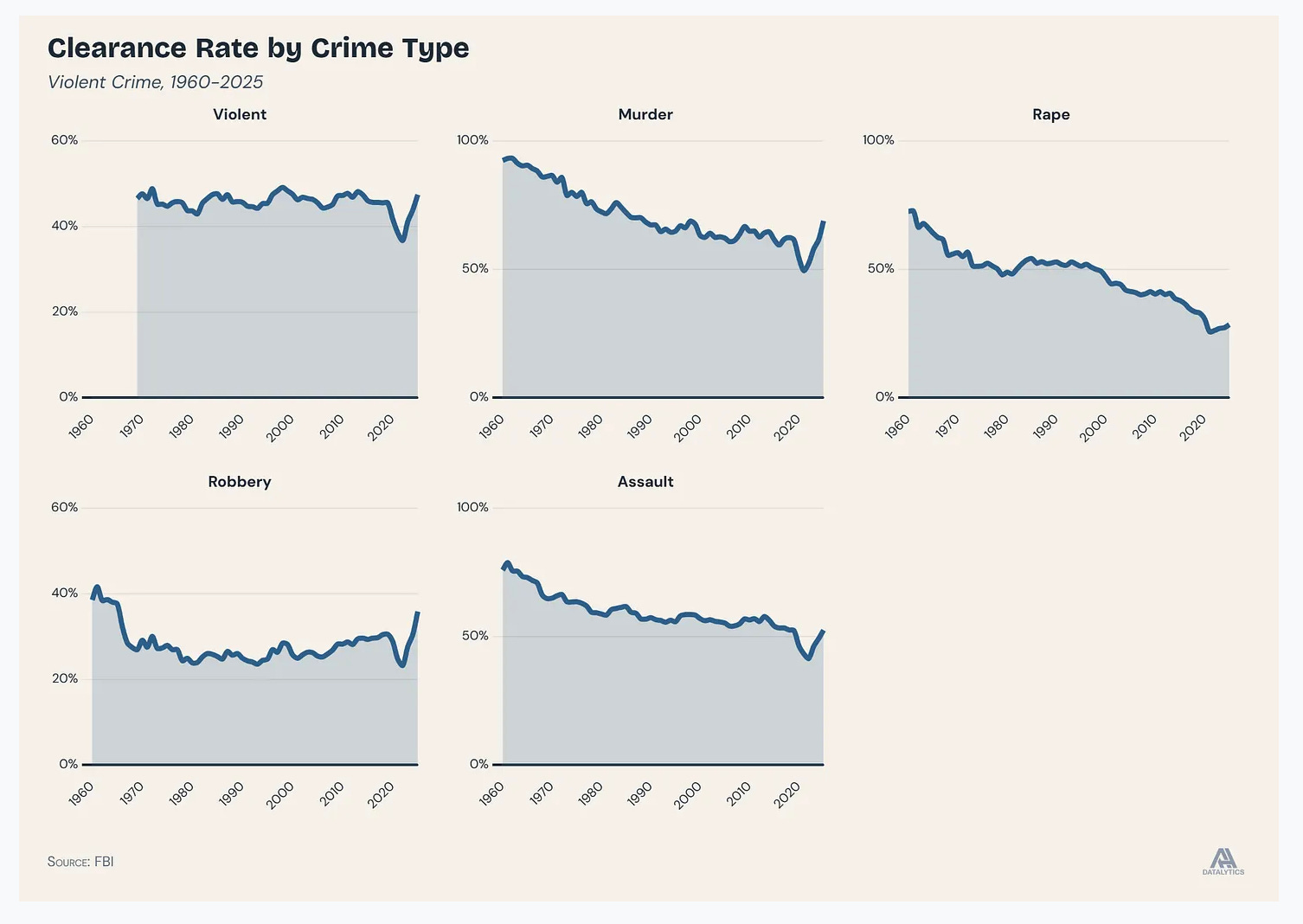
Much has been written about America’s historic crime decline, but one part of the story has received far less attention: police are solving substantially more crimes. Crime analyst Jeff Asher reports in Jeff-alytics that the national violent-crime clearance rate reached 47% in 2025, its highest level in a decade and more than 10 percentage points above 2022. The murder clearance rate climbed to 68.8%—the highest since 1988 and up 16.5 points in just three years—while robbery clearances reached 35.8%, the highest since 1965. Even burglary improved, with its 17.4% clearance rate the best since 1975. The gains come as murder, violent crime and property crime all recorded historic declines, adding another significant data point to the story of falling crime nationwide. 📉 More Jeff-alytics
Code Enforcement Cuts Calls
A randomized controlled trial by James D. Kelsay, Shane Diller and Jaya B. Davis, just published in the Justice Evaluation Journal, found that targeted code enforcement in crime hot spots produced larger reductions in calls for service than occurred in control locations. The researchers tested whether increased code enforcement could produce public-safety benefits similar to traditional police-led hot spots strategies, but without concerns associated with aggressive enforcement. Treatment areas experienced statistically significant reductions in calls involving residential burglaries and auto thefts, suggesting that focused enforcement of municipal codes may be another tool for reducing crime and disorder in high-crime locations. 📖 More here