

Explosive Hits Patrol Car
A Mesa officer was sitting in his patrol car early Thursday when someone threw a lit explosive device at it. Arizona’s Family reports the officer had stopped with his emergency lights on at 96th Street and Sunland Avenue while searching the area after a 6 a.m. shots-fired call. Video from a nearby home shows the device land, roll toward the car and explode five seconds later. Police say it was intentionally thrown and damaged the car with the officer inside. He was taken to a hospital as a precaution and released later that day. Christopher Byasse, 57, faces charges including aggravated assault against law enforcement, arson and weapons misconduct. Police say he is prohibited from having a weapon. Christopher Jones, 55, was booked on arson and criminal damage. 💥 🔗 More here.
Big-City Murders Down 17%
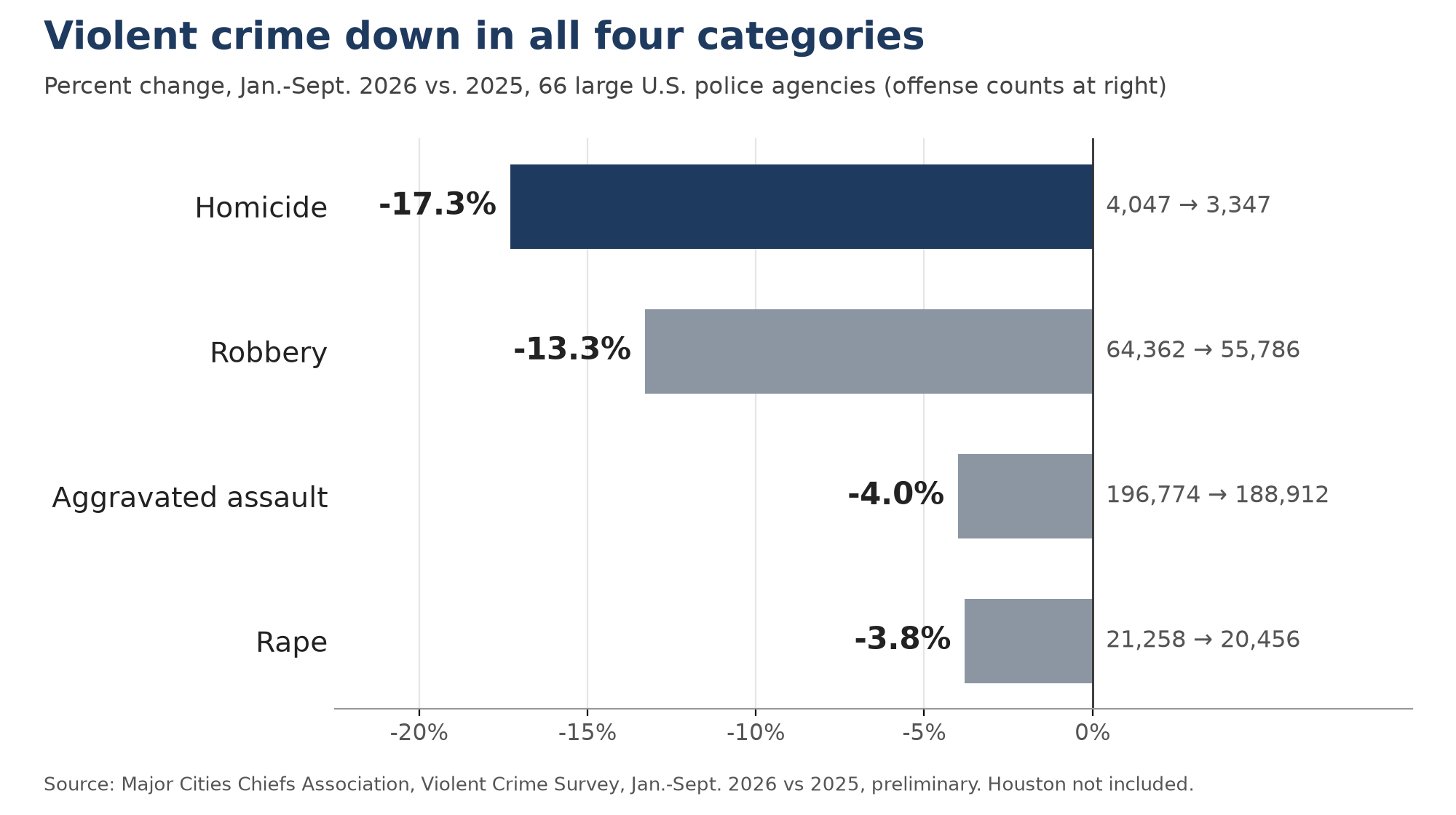
Homicides fell 17.3% across 66 large U.S. police agencies in the first nine months of 2026, Axios reports from new Major Cities Chiefs Association figures. The count went from 4,047 to 3,347. Robbery was down 13.3%, rape 3.8% and aggravated assault 4%. Fifty-two of the 66 agencies reported overall declines, and homicides fell in 50 of them. Memphis went from 156 homicides to 99. Aurora, Colo., was down 65.2% and Newark 59.1%. San Diego (up 45.2%) and Las Vegas (up 23.4%) went the other way. Washington, D.C., saw homicides fall 29.9% while robberies rose 41.1%. The numbers are preliminary, and Houston reported no data because of a records-system transition. 📉 🔗 Axios and the MCCA report.
AI Match Isn’t Probable Cause
A federal judge in Kentucky has refused to throw out a wrongful-arrest suit against a Florence police detective accused of relying on a facial recognition match alone. Alain Vizcay Osorio, a Nebraska resident, says he was arrested in Florida and jailed more than two weeks over a suspected fraudulent check someone tried to cash in 2024. The charges were dismissed with prejudice after he showed he was working in Nebraska at the time. Florence’s own policy calls the technology “advisory” and says it does not establish probable cause without further investigation. In a Nov. 9 opinion, U.S. District Judge S. Chad Meredith denied qualified immunity for now, noting that discovery might show “more to the story.” The Fourth Amendment “does not allow a detective to delegate to AI the task of assessing probable cause,” he wrote. ⚖️ 🔗 Read the opinion.
Fort Worth Murders Down 40%
Fort Worth homicides are down almost 40% year to date, Chief Eddie Garcia told CBS Texas while going over the department’s third-quarter crime report. For the quarter itself, murder was down about 30%. The report shows a 7.1% drop from last year in offenses such as aggravated assault, murder and burglary. “I know we have two months to go, and one life is too many,” Garcia said. He credits looking at deployment “from a data lens” and leaning on technology. “We can’t have an officer on every street.” CBS Texas notes the city of more than a million is reporting lower homicide, robbery and aggravated assault numbers than Dallas and San Antonio. 📉 🔗 More here.
Phoenix Drones Answer 911
Phoenix police and fire have launched a joint Drone as First Responder program, Arizona’s Family reports. When a 911 call inside the service area qualifies, pilots can send a drone within moments to stream live video to responding crews. The departments say crews will see “incident conditions, access points, traffic impacts, and potential hazards” before they arrive. The stated goals are fewer unnecessary responses, better first responder safety and more readiness for emergencies. Mesa, Scottsdale, Glendale and Peoria already run similar programs. 🚁 🔗 More here.
AI Voices Fool 911
Swatting calls are getting harder to spot because the callers are using AI-generated voices, NPR reported this week. A bomb threat that canceled classes at Wheatland Union High School in Yuba County, Calif., came from one. “Those voices used to be pretty easy to recognize, but now they’re natural sounding,” says APCO International CEO Mel Maier. “They can insert pauses.” In an APCO and Public Safety Threat Alliance survey of 766 public safety communications professionals, published in June, about 14% said they had been targeted using AI tools. A Florida Tech professor says he can clone his own voice for less than $20. NENA’s April Heinze says most swatters avoid dialing 911, which reveals location and a callback number. They call police lines or courthouses and get transferred. APCO is building interrogation training around questions too specific for AI to answer. 🔗 More here.
Council Rejects Chief
The Minneapolis City Council voted Thursday to reject interim Chief Bill Peterson as the department’s permanent chief, MPR News reports. Eight members voted no, several citing MPD’s history of “biased” policing. Council member LaTrisha Vetaw said she preferred north side precinct commander Charlie Adams. Peterson joined the department at 21 and became interim chief when Brian O’Hara resigned in May. Mayor Jacob Frey had nominated him. MPD is still carrying out reforms required by a 2023 agreement with the state human rights department, while struggling with staffing and overspending. 🔗 More here.
SF Cameras, Fewer Break-Ins
San Francisco car burglaries have dropped from a high of 31,000 a year to fewer than 3,000 this year, SFPD Capt. Stephan Jonas tells KOMO News. He calls it a 90% reduction. The department also says overall crime is down nearly 50% since 2023. Its Real Time Investigation Center, opened in 2024, can tap about 400 cameras run by business improvement districts and community groups, and voters approved nearly 100 police drones. Footage is generally reviewed after a crime is reported. Live viewing is reserved for life-threatening emergencies or operations approved by a captain or above. KOMO watched drones follow a stolen car flagged by a plate reader until plainclothes officers moved in and made an arrest. 🔗 More here.
FBI Flags AI Hacking Tool
The FBI issued a FLASH alert Nov. 13 on ARTEX, an open-source AI agent platform that hackers have turned into a way to automate intrusions “at machine speed,” from reconnaissance through data theft. Users describe goals in plain language and the AI agents carry them out. Since at least August, attackers have used it against financial, government, defense, healthcare and other sectors. The bureau says some intrusions went from first targeting to privileged access in under three hours, and that the tool lets people “with minimal technical expertise” run complex campaigns. The developer pulled the GitHub repository in October. Researchers found more than 1,600 publicly exposed ARTEX consoles in early November. The alert lists indicators of compromise and mitigations. 🔗 Read the FLASH.
Old Records, Fading Risk
How long does a prior charge predict new offending? A recent Criminology paper, posted to the open-access archive CrimRxiv this week, takes it on with 40 years of criminal charges from five states, covering 16.6 million people and 746 million person-year observations. Zachary Hamilton, Alex Kigerl, Jennifer Tostlebe and John Ursino find risk follows an exponential decay after a prior charge. Each additional year brings a proportional drop in the odds of offending. The pattern holds across locations, demographic groups, offense types, incarceration and time periods. Starting risk differs, but within 9 to 10 years it converges with the general population’s base rate. The authors say static criminal-history measures may overstate reoffending risk. 📊 🔗 Read the study.
Fairfax Posts Its Flights
Fairfax County residents can now look up police drone and helicopter missions. Chief Kevin Davis announced three public dashboards Friday, 7News reports, calling them another transparency step after the department encrypted its radio channels earlier this year. The drone and helicopter dashboards list deployments back to Oct. 1, 2026, with the mission type and police district or fire station, FOX 5 DC reports. A third map shows active calls for service, refreshed every five minutes. Markers disappear as users zoom in, so no one can pinpoint a home. “We are not engaged, ever, in trying to cover up anything or to sweep anything under the proverbial carpet,” Davis said. 🔗 7News and FOX 5 DC.
Drone Spots a “Help Us” Sign
Kissimmee police sent a drone to a domestic call and found kids hiding in a room. One held a “HELP US” note up to the window. Officers got the children out while the suspect was distracted, and he later surrendered.
AI Takes Citrus Calls
Call the Citrus County, Fla., non-emergency line and an AI operator may pick up first. Sheriff David Vincent tells Bay News 9 the system has handled about 60% of the agency’s non-emergency calls so far. The emergency operations center averages about 5,000 calls a week. The goal is to keep call takers focused on 911, Vincent said, not to replace dispatchers. Some residents raised concerns after the sheriff’s office announced it on Facebook. Vincent says callers can ask for a person at any time. “If you have a true emergency, you’re always going to get a human on 911.” A University of South Florida professor hopes agencies keep staff trained for a day when the systems aren’t available. 🔗 More here.
Traffic Deaths Keep Falling
U.S. traffic deaths fell 2.5% in the first half of 2026, to 16,750 from 17,175 a year earlier, Reuters reports from National Highway Traffic Safety Administration figures. That’s the lowest first-half number since 2015. The fatality rate dropped to 1.02 per 100 million vehicle miles traveled, the lowest since 2014. Deaths fell 5% in the first quarter but just 0.2% in the second. NHTSA says the year is on pace for a fifth straight annual decline. Full-year 2025 deaths were the lowest since 2019. Bicyclist deaths went the other way, up 4% last year to 1,148. 🚗 🔗 More here.